Table of Contents
Zen Meditation: Sitting in Stillness (2026 Practical Guide)
There's a whisper underneath all the noise.
You know the noise I'm talking about. It's the piling-up of to-do lists, the endless scroll of news and feeds, the internal soundtrack that's always reviewing, planning, or worrying. Our modern creed seems to be: do more, be more, optimize yourself. It's exhausting.
And then there's Zen. Which, in its breathtaking simplicity, quietly suggests the exact opposite: Sit down. Be here. Do nothing.
The first time I tried Zen meditation, zazen. I nearly laughed with frustration. I was in a spare, quiet room, on a round black cushion called a zafu, trying to follow the instruction to "just sit." My mind was a fireworks display of thoughts: Is my back straight? This hurts. What's for dinner? I'm terrible at this. Is that person over there enlightened? I spent half the session silently counting the number of times I wanted to get up and leave. I was convinced I was failing at something called "doing nothing."
Here's the secret I was missing, the one that changed everything: Zen meditation isn't about achieving a state of perfect blankness. It's about undoing. It's about un‑becoming, for a few moments, the person who is always trying to get somewhere else.
In this 2026 guide, I want to demystify that. I want to walk you through the beautiful, grounding, radically simple practice of sitting in stillness, zazen, and show you how this ancient practice is perhaps the most relevant antidote to our always-on, digitally-saturated 2026 lives. No robes required, no special beliefs necessary. Only you, your breath, and a willingness to be present.
What Zen Meditation Really Is (And Isn't)
Let's begin by clearing up some common misunderstandings. When you think of Zen meditation, you might imagine a monk in total silence, with an empty mind, free from any worry or pain.
That's not it. And thank goodness, because that would be impossible for most of us.
Zen meditation (zazen) is NOT:
- "Emptying the mind": Your mind will think. That's its job. The goal is not to create a vacuum.
- Chasing dramatic enlightenment: While Zen has profound depths, the daily practice is remarkably ordinary. It's about showing up, not collecting spiritual achievements.
- Escaping real life: It's about seeing your real life: bills, joys, aches, worries, more clearly and calmly.
So what IS it? At its core, the specific practice I'll focus on is called shikantaza, which translates to "nothing but precisely sitting" or "just sitting." It's the heart of Zen.
Quick Comparison: Mindfulness vs. Zen
| Aspect | Mindfulness Meditation | Zen Meditation (Zazen) |
|---|---|---|
| Focus | Breath/Body sensations | Whole field of awareness |
| Goal | Present-moment awareness | "Just sitting"/Being |
| Eyes | Usually closed | Half-open, soft gaze |
| Thoughts | Observe & return | Let be, include in awareness |
| Approach | Technique-focused | Being-focused |
Imagine this: You sit down. You adopt a dignified, relaxed posture. You breathe. And then… You just let everything be. Sounds arise and fade. Thoughts come and go, a memory, a plan, a judgment. Physical sensations, an itch, a warmth, a tension, flow through. Your job isn't to analyze them, entertain them, or fight them. Your job is to notice them, and gently, continually, return to the simple, embodied fact of sitting here, breathing.
It's different from some other practices you might know:
- Vs. Guided Meditation: No one is leading you. You are your own guide, resting in your own awareness.
- Vs. Mindfulness of Breath: While breath is an anchor, the focus in shikantaza widens to include the whole field of experience, not just the breath, but also sounds, sights (with eyes softly open), and the flow of mind itself.
- Vs. Mantra Practice: There's no word or phrase to repeat. The "object" of meditation is simply your whole, present-moment experience.
It's a practice of profound trust, trust that in simply being present, without manipulation, something settles, clarifies, and heals on its own.
You might be thinking: simple in theory, hard in practice. And you're exactly right, the simplicity is the tricky part. If you're hitting those early bumps, I talk more about common meditation struggles and how to work through them here.
The Science of "Doing Nothing"
Sitting still and "doing nothing" feels countercultural. We're wired for productivity. So it's deeply reassuring to know that modern science confirms what Zen practitioners have felt for centuries: this "non-doing" is actively, beneficially changing your brain and body.
When you practice shikantaza, this open, non-judgmental awareness, neuroscientists see fascinating things happen:
- Reduced Activity in the Default Mode Network (DMN): The DMN is your brain's "background noise" engine; it's active when you're daydreaming, ruminating about the past, or worrying about the future (the "monkey mind"). Regular zazen quietens this network, leading to less obsessive thinking and a quieter mental landscape.
- Increased Gray Matter: A 2025 study in Frontiers in Human Neuroscience found that long-term meditation practitioners have increased gray matter density in areas related to attention, emotional regulation, and self-awareness, such as the prefrontal cortex.
- Enhanced Meta-Awareness: This is a fancy term for a simple yet game-changing skill: being aware that you're thinking while you're thinking. Instead of being lost in a thought ("I'm a failure"), you can notice the thought ("Ah, there's a thought about failure"). This creates space and freedom.
Recent research continues to support what traditional practice has known: when you sit in stillness, you are not wasting time. You are engaging in a profound act of neural and emotional hygiene. You are literally rewiring your response to life.
Preparing Your Space and Body: Intention Over Aesthetics
You don't need a perfect Japanese rock garden or a silent temple. You need a few square feet of floor and a commitment to show up. Setting a simple space is about honoring your intention, not creating a photo-op.
Budget-Friendly Starter Setup:
- Seat: Firm couch cushion or folded blanket
- Support: Straight-backed chair if needed
- Space: Quiet corner of any room
- Timer: Phone app (free options available)
Practical Tips for Your 2026 Practice Space:
- Choose a relatively quiet spot, but don't wait for perfect silence. Part of the practice is including ambient sounds.
- Face a blank wall if possible. It minimizes visual distraction, just like in a traditional zendo.
- Let your space be simple and clean-ish. It sets a tone.
A note on gear: You can start with zero investment. But if you practice regularly, a few items can support your posture and commitment.
Disclosure: Some of the links below are affiliate links. If you buy through them, I may earn a small commission at no extra cost to you. I only recommend what I genuinely find helpful.
Supportive Gear for Regular Practice:
- Traditional Zafu Cushion: Adjustable buckwheat hull filling provides firm, customized support. Better for posture than soft pillows.
- Seiza Meditation Bench: Game-changer for knee/ankle issues. Allows a comfortable kneeling position.
- Simple Meditation Timer: Free apps like "Insight Timer" or a basic kitchen timer work perfectly.
- Atmosphere Elements: Optional items like Japanese sandalwood incense or a simple candle can help signal "practice time" to your brain.
The Heart of the Practice: A Step-by-Step Zazen Guide
Here's where we get practical. Let's break it down into the physical foundation and the mental practice.
Part A: The Physical Foundation – Your Posture of Dignity
Your posture isn't about being stiff or twisting yourself into uncomfortable shapes. It's about finding a position that's both relaxed and awake, a comfortable seat for your attention. Think of it as calm and collected.
60-Second Start Guide:
- Sit upright (chair or cushion)
- Hands in lap, thumbs touching lightly
- Eyes half-open, soft gaze down
- Breathe naturally
- Notice when your mind wanders, gently return
Choose Your Seat (Options for 2026 Practitioners):
- Burmese Position (Most Accessible): Cross-legged with both feet flat on the floor. One calf in front of the other. Works for most beginners.
- Seiza (Kneeling): Using a meditation bench or cushion between the legs. Excellent back support. Good for those with hip flexibility issues.
- Chair Position (Office-Friendly): Sit forward, away from the backrest. Feet flat on the floor, knees at 90 degrees. Spine self-supporting.
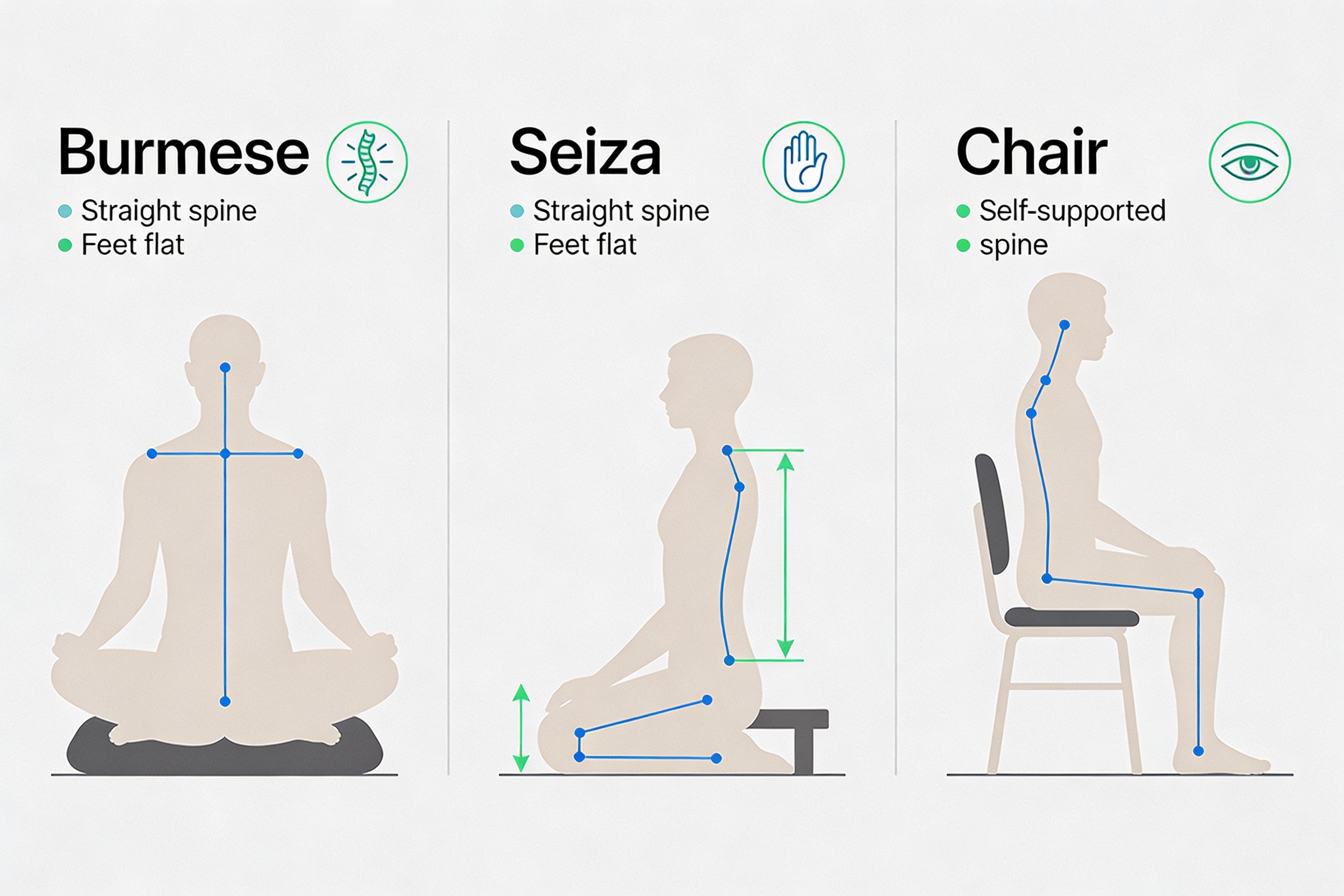
Alignment Checklist:
- ✅ Hips: Elevated slightly higher than knees (if on cushion)
- ✅ Spine: String lifting crown of head upward, chin slightly tucked
- ✅ Hands: Cosmic mudra (dominant hand up, other hand on top, thumbs touching)
- ✅ Shoulders: Rolled back and down naturally
- ✅ Eyes: Half-open, soft gaze 2-3 feet ahead
- ✅ Breath: Natural, felt in lower belly
Part B: The Mental Practice – The Art of "Just Sitting"
This is shikantaza. You've built the container. Now, let everything be.
The Process:
- Settle: Take 2-3 conscious breaths to arrive
- Widen Awareness: Like a wide-open sky holding everything
- Notice When Caught: In thought, memory, planning
- Gently Return: To the physical sensation of sitting
- Repeat: This returning IS the practice
Analogy for Modern Practitioners:
Think of yourself as a mountain in 2026's digital storm. Thoughts, notifications, and worries are weather patterns, passing clouds, sunshine, rain, and storms. The mountain doesn't chase the clouds or fight the storm. It just sits, grounded, through all seasons of experience.
Starter Option: Counting Breath (Susokkan)
If "just sitting" feels too vague:
- Silently count "one" on exhale, "two" on next, up to ten
- When you lose count (you will), start back at one
- This trains gentle focus before opening to shikantaza
Common Challenges (and The Zen Way Through Them)
Every single one of these is normal in 2026. You are not broken.
💡 Pro Tip Reference Chart:
| Challenge | Immediate Fix | Zen Perspective |
|---|---|---|
| "Can't stop thinking." | Label "thinking," return to posture | Thoughts are weather; you are the sky |
| Physical discomfort | Adjust mindfully, use support | Distinguish ache (observe) from pain (adjust) |
| Sleepiness | Straighten spine, lift gaze slightly | Body interpreting stillness as a sleep cue |
| Digital distraction urge | Notice urge, don't follow it | Modern version of restlessness |
| "Am I doing this right?" | Let the question sit without an answer | Great doubt = fertile ground |
The 2026-Specific Challenge: Digital Urge
This wasn't as prominent in traditional teaching but dominates modern practice. That itch to check your phone mid-sit? Notice it as another sensation. The thought "I should be productive"? Watch it like a passing cloud.
For more on navigating these inner roadblocks, I've gathered more thoughts in my guide on common meditation challenges for modern practitioners.
Zazen in 2026 Life: Ancient Practice, Modern World
You don't need to become a monk to benefit. The practice meets you where you are right now.
Modern Adaptations That Work:
- The 5-Minute Digital Buffer: Before opening the laptop/phone in the morning and evening.
- Desk Chair Zazen: Between meetings, 3-minute reset
- Family-Integrated Practice: While coffee brews, after the kids sleep
- Walking Bridge (Kinhin): Mindful walking between digital tasks
Building Consistency in 2026:
- Start Micro: 3 minutes daily beats 30 minutes never
- Habit Stack: "After I pour coffee → 3 breaths."
- Non-Heroic Tracking: Date + one word ("restless," "calm," "okay")
- Digital Sangha: Online practice groups when in-person isn't possible
When to Seek a Teacher
Books and guides can get you started. But Zen is traditionally transmitted from teacher to student. Consider finding guidance when:
Signs You Might Benefit from a Teacher:
- Consistent questions that articles can't answer
- Feeling stuck in persistent patterns
- Drawn to deeper koan study
- Wanting community accountability
Finding Reputable Guidance in 2026:
- Look for established centers with online options
- Check for clear ethical guidelines
- Avoid "paywall enlightenment" schemes
- Start with introductory workshops or retreats
Great starting points are directories of established centers that have adapted to post-pandemic practice models.
Your 2026 Practice Challenge
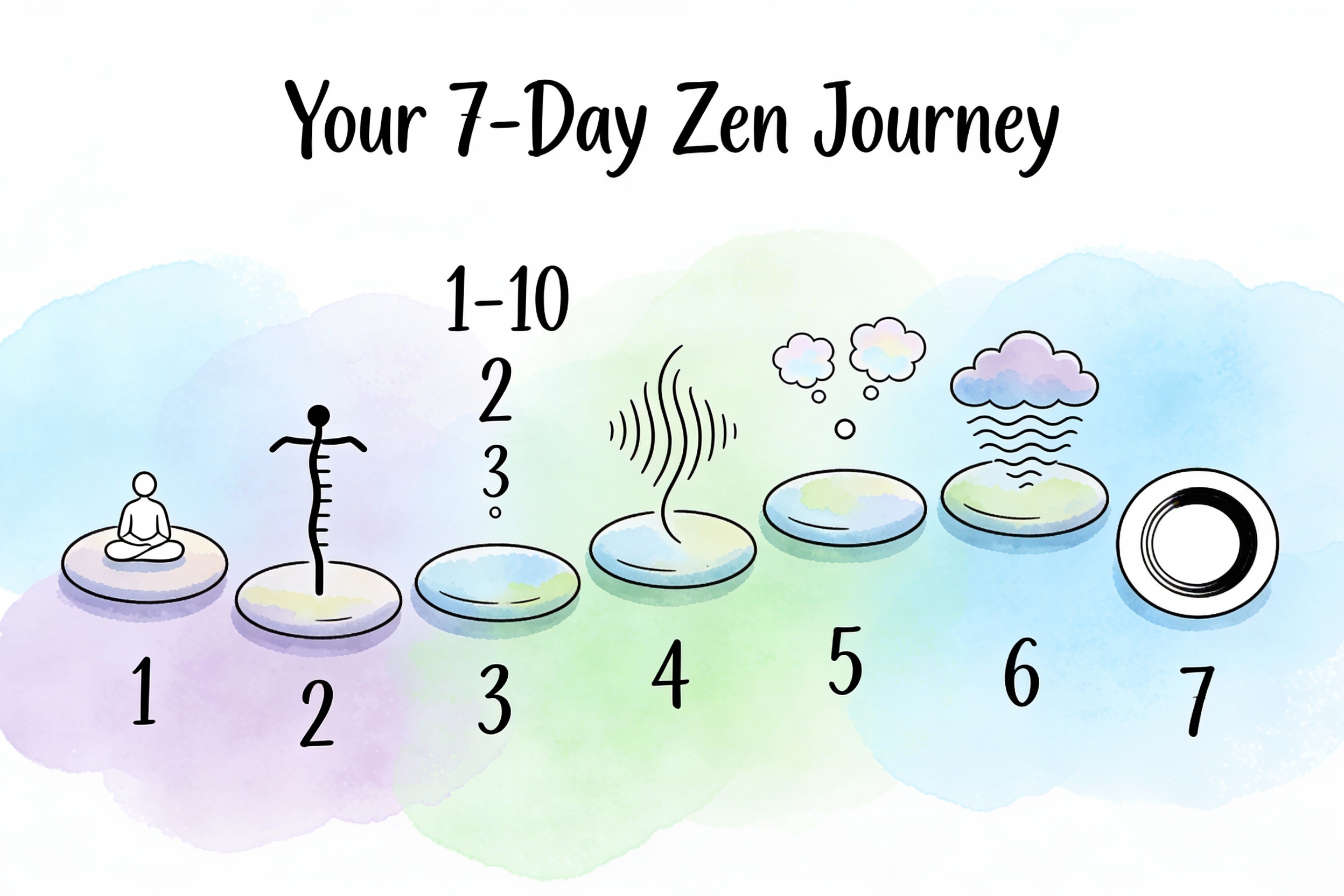
7-Day Zazen Starter Challenge
The Commitment: 5 minutes daily for 7 days
Daily Focus:
- Day 1: Just sit. Notice everything without changing it.
- Day 2: Pay special attention to your posture. Adjust for comfort.
- Day 3: Try counting breaths (1-10) when the mind feels chaotic.
- Day 4: Include ambient sounds in your awareness.
- Day 5: Notice spaces between thoughts.
- Day 6: Practice after a stressful moment.
- Day 7: Sit without any goal whatsoever.
Track Your Journey:
- [ ] Day 1: _________
- [ ] Day 2: _________
- [ ] Day 3: _________
- [ ] Day 4: _________
- [ ] Day 5: _________
- [ ] Day 6: _________
- [ ] Day 7: _________
Note one word after each sit: calm, restless, sleepy, okay, etc.
The Gift of Just Being in 2026
In a world that demands constant output, choosing to sit in stillness is a quiet revolution. It's a direct, bodily declaration that you are a human being, not just a human doing.
Zen meditation won't solve all your problems. But it will change the you who meets those problems. It creates a space, a still point, within the turning world. From that space, you might find your responses become a little wiser, your heart a little more open, and your life a little less like a frantic race and a little more like coming home.
So here's my invitation to you for 2026: Try it. For seven days, sit for just five minutes each day. Don't look for fireworks. Notice the confusion, the peace, the boredom, the single breath that felt completely easy. All of it belongs.
And if you try it, I'd love to hear what you notice. Share in the comments below, your experience, however "imperfect," is part of this beautiful, human conversation.
May your sitting be deep, your heart be light, and your stillness resonate through all your days.



Comments (0)
No comments yet. Be the first to comment!
Leave a Comment