
Table of Contents
Common Mindfulness Obstacles: Simple Ways to Move Through Struggle
People often talk about mindfulness as if it were easy, simply by breathing and being present. Yet every time I close my eyes, my brain throws different acts play about yesterday’s emails and tomorrow’s to-do list. I used to sit there, gritting my teeth, waiting for the profound peace I’d read about. All I got was an itch on my nose and a mental replay of that awkward thing I said many years ago.
Sound familiar?
If you have ever thought, “I am bad at this,” or “Why can’t I meditate?”, let me whisper something important: you are not broken. You are human. Forget the perfect zen you see online. Real mindfulness is messy, distracted, and frustrating. That mess is not failing; it is you practicing.
This post is not a quick fix. It is an honest, kind map through the most common mindfulness obstacles that every practitioner faces. Consider it a guide from someone who has face-planted into every single one of them. These are not roadblocks; they are the curriculum.
Let’s walk through the struggles almost everyone meets, and what to do when mindfulness feels impossible.
Obstacles as Pathways: Your Struggle is the Practice.
Before we dive in, let’s gently shift perspective. We tend to approach mindfulness like a task to ace. We think a “good” session means a quiet mind, and a “bad” one means we have failed. This mindset is the first, and biggest, obstacle.
The truth is, the obstacles are the practice. Learning to meditate is exactly like learning to surf. You don’t stop the waves, your thoughts, your boredom, your impatience. You learn to find your balance while they move. You have not failed when your mind wanders. You succeed the second you notice it wandered. That is the practice.
As Jon Kabat-Zinn beautifully said, “You can not stop the waves, but you can learn to surf.” So let’s drop the goal of a perfectly calm ocean and get curious about the waves themselves.
Here are the stumbling blocks that nearly everyone meets, and how to walk through them with compassion, not combat.

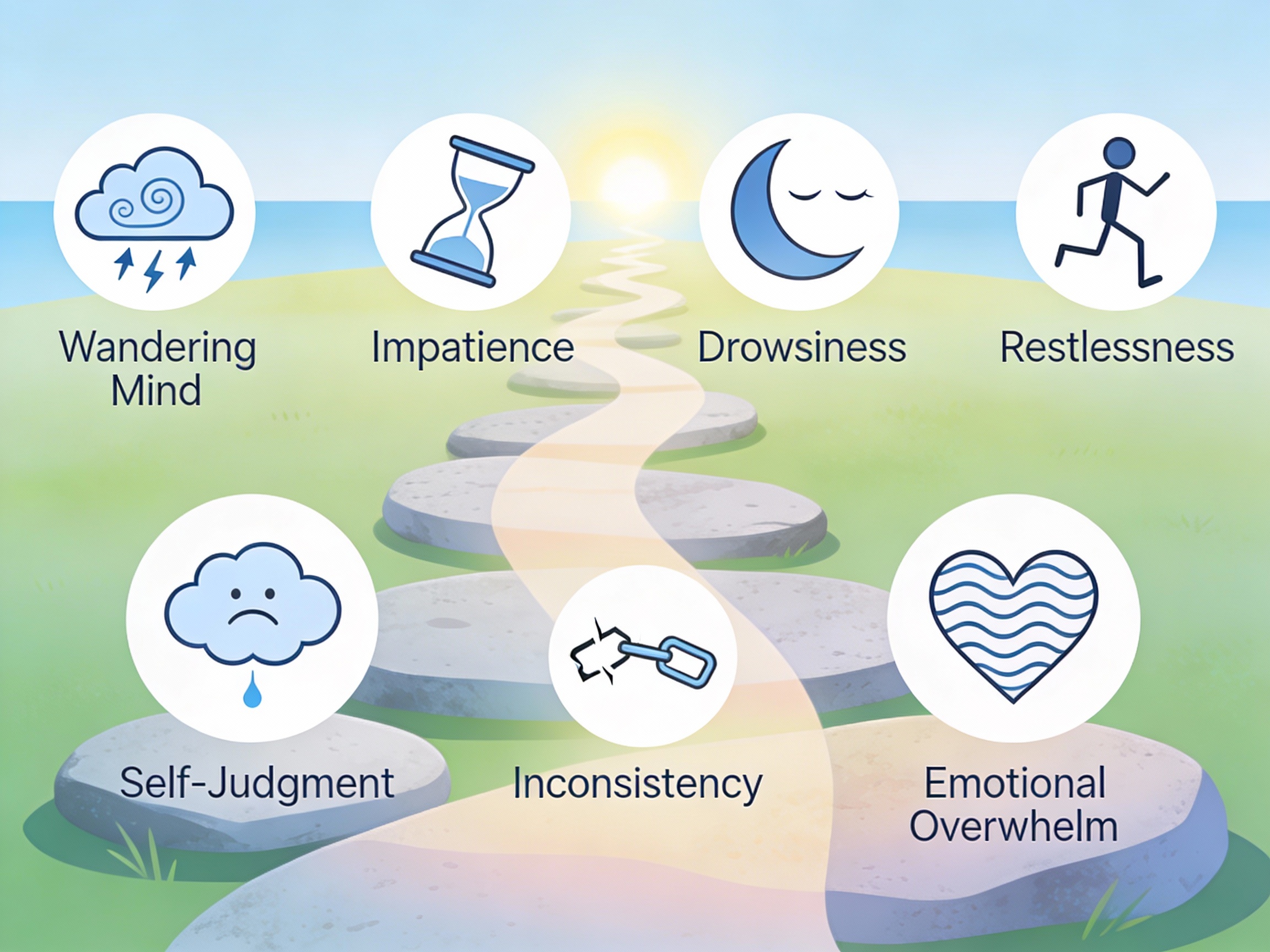
7 Common Mindfulness Obstacles & Practical Responses
1. The Wandering Mind (“My brain won’t shut up.”)
The Experience: You settle in, follow the breath for maybe three seconds, and then… You are mentally designing your dream kitchen, rehearsing a difficult conversation, or writing a grocery list. Frustration follows: “I can not quiet my mind! What is wrong with me?”
What To Do: First, celebrate. The fact that you noticed you are thinking is the entire point. That is awareness waking up. Instead of fighting the thoughts, try this: when you realize you have drifted, label it softly in your mind: “thinking.” Say it with the gentle tone you would use to note, “Oh, it’s raining.” Then, softly return to your anchor, the breath, a sound, a bodily sensation.
Think of it as a bicep curl for your awareness muscle. The curl is not “holding the weight still”; it is the movement of lifting it, lowering it, lifting it again. Your mind wandering and you bringing it back is the repetition. It is the exercise. I used to get so angry at my mental marathons. Now, I sometimes laugh mid-meditation. “Ah, we are planning the weekend again. Hello, planning mind. Back to the breath.”
2. Impatience (“I’m not getting calmer fast enough.”)
The Experience: You have been “doing this” for a week (or a month, or a year) and you are still anxious, still reactive, still you. The inner voice whispers, “This is not working. When do I get the benefits?”
What To Do: Replace goals with curiosity. Mindfulness is not a project with a finish line. It is a relationship you cultivate. The expectation of instant transformation is a heavy backpack; put it down. Focus on consistency, not intensity. It is better to sit for three minutes, five days in a row, than to force a 30-minute session you dread.
A tool that helped me immensely was shifting my measure of success. Instead of “Am I calm?” I started asking, “Did I show up?” After each short sit, I would write down one sentence in a notebook. “Felt restless, but sat.” “Noticed the bird sounds.” This ritual, done in a dedicated mindfulness journal, built a visible record of my commitment, not my “performance.” Over time, I could see the invisible progress.
3. Drowsiness (“I just fall asleep every time I close my eyes.”)
The Experience: The intention is clear, but the moment you find stillness, your body seems to think, it’s bedtime. You nod off, jerk awake, and feel like you have failed at being “aware.”
What To Do: Your nervous system might be interpreting stillness as a signal to shut down, especially if you are tired. Honor that, maybe you need rest! If you want to practice through sleepiness, change your posture. Sit upright on a supportive meditation cushion that tilts your pelvis forward, keeping your spine naturally alert. Or try meditating with your eyes softly open, gazing at the floor. You can even practice standing or mindfulness walking. If you consistently fall asleep, try a short session. A bright, alert 5-minute practice is worth more than a 20-minute nap.
4. Restlessness & Boredom (“I feel like I need to MOVE.”)
The Experience: Itchy, twitchy, and profoundly bored. The mind screams, “This is pointless! We could be doing something productive!” This is a classic mindfulness challenge, the addiction to doing and stimulation against the simplicity of being.
What To Do: Do not fight the energy; include it. Make the restlessness or boredom itself the object of your mindfulness. Where do you feel the impatience in your body? A jitter in the legs? A tight chest? Observe those sensations with interest. Alternatively, choose a practice that involves motion. Mindful walking is a profound practice, feeling the lift, move, and place of each foot. Or practice focused listening, hearing all the layers of sound in your environment without labeling them. To keep sessions manageable, I use a simple analog meditation timer. It lets me set an intention without the temptation of my phone, the ultimate boredom-relief machine.
5. Self-Judgment (“I’m just bad at this.”)
The Experience: The inner critic hijacks the session. “You are doing it wrong. Everyone else can do this. You are not peaceful/spiritual/disciplined enough.” This voice can be the most corrosive of all meditation difficulties.
What To Do: Meet judgment with its opposite: kindness. This is where loving-kindness (Metta) practice can be a game-changer. Start by offering simple phrases to yourself: “May I be kind to myself. May I be patient. May I accept this moment?” You don’t even need to feel it, just offer the words. When the critic pipes up, hear it as a signal that your heart needs a little gentle attention. That harsh voice is often just a scared part of you that thinks it needs to whip you into shape. See if you can thank it for its concern, and then return to a kinder mantra.
6. Inconsistency (“I can’t stick with it.”)
The Experience: Life gets busy. You miss a day, then three, then a week. The momentum is gone, and starting again feels harder than the first time. This is perhaps the most universal of mindfulness for beginners' struggles.
What To Do: Make it so easy you can not fail. Do not chase a perfect month. Instead, add a tiny bit of awareness to things you already do. Breathe once after brushing your teeth. Feel the water on your hands before washing dishes. Notice how you are sitting before you start work. Link mindfulness to your daily habits. If it helps, put a check on the calendar each day you do it. That checkmark is proof you showed up, and that’s enough.
7. Emotional Overwhelm (“Meditation makes me cry / anxious.”)
The Experience: When we are busy, we can shove our feelings to the side. But when we finally get still and quiet, there is nothing to hold them back. All the sadness, anxiety, or anger we have been carrying can come rushing up. It is scary, you sat down looking for calm and got hit with an emotional storm instead.
What to do: First, know this is actually a good sign, not a bad one. It means you are safe enough to finally feel what you have been carrying. The trick is to let the feelings in without drowning in them. Here's a simple method called RAIN:
Recognize what’s arising. “Ah, this is sadness.”
Allow it to be here, without trying to fix or push it away.
Investigate with gentle curiosity. Where do I feel this in my body? What shape, temperature, or texture does it have?
Nurture yourself. Place a hand on your heart. Offer yourself the kindness you would to a hurting friend.
This is healing in action. If feelings feel too big, open your eyes, feel your feet on the ground, and know you can return to the practice later. You are in charge.
Cultivating the Right Attitude: Your Inner Compass
Navigating these obstacles is not about clever techniques. It is about the underlying attitude you bring to your cushion, and to your life. Jon Kabat-Zinn outlines seven foundational attitudes of mindfulness. They are the antidotes to the struggles above:
Non-Judging is the salve for self-criticism.
Patience directly disarms our impatience.
Beginner’s Mind helps us see restlessness with fresh curiosity, not boredom.
Trust in your own experience combats the feeling of “doing it wrong.”
Non-Striving releases the pressure to achieve a certain state.
Acceptance allows emotional overwhelm to move through.
Letting go is how we release the wandering thought and come back.
We do not practice to get calmer. We practice to learn how to meet what is true, however it appears, with a little more space and a little more heart.
Conclusion: The Doorway Back to Now
If you take one thing, let it be this: The obstacles are the practice. The moment you notice you are judging yourself for having a wandering mind, be mindful. It is working. You are surfing.
This path is not about arriving at a perfect state of blank serenity. It is about coming home, again and again, to the aliveness of this present moment, even when it is itchy, boring, sad, or frustrating.
So here’s my invitation to you this week: Pick one of these seven obstacles. The one that rings the loudest bell. Maybe it is impatience, or it is the critic. Work with it gently. When impatience arises, smile and say, “Ah, there you are.” See what happens when you meet your frustration, not as a failure, but as a doorway back to now.
A Final Note: This journey is your own, but it does not have to be lonely. If you find that reflecting helps integrate your practice, a beautiful, dedicated mindfulness journal can be a wonderful companion to track the subtle shifts that happen over time.
I would love to hear from you. Which of these obstacles feels most familiar? What is one tiny way you will work with it this week? Share in the comments below, or subscribe to our newsletter for weekly nuggets of mindful encouragement. Remember, you are not alone in the beautiful, messy, human work of waking up.
Want to explore more? Check out our guides on Walking Meditation and Loving-Kindness (Metta) Practice. For further reading, the resources at Mindful.org are excellent.




Comments (0)
No comments yet. Be the first to comment!
Leave a Comment