Body Scan Meditation: Awareness Through Sensation
Last Tuesday at 3 AM, I was lying awake in my Kathmandu apartment, listening to the distant barking dogs and feeling my mind race between tomorrow's deadlines and yesterday's regrets. My shoulders were tight from bending over my laptop, my jaw tense as if holding back words I had not spoken. I realized with sudden clarity: I had become like so many of us here, so focused on surviving the daily hustle, navigating power cuts, traffic jams, and family expectations, that I had completely stopped listening to my own body.
That's when I remembered something my grandmother used to do every morning in her home in Kavre.
Before her morning tea, before her prayers, she would sit quietly on the floor in her bright kitchen. She would close her eyes and take three slow breaths, her hands resting gently on her knees. She was not "meditating" in the Western sense. She was doing what her mother taught her, simply "checking in" with herself. Feeling where the stiffness was from yesterday's work in the garden. Noticing the cool morning air on her skin and observing the rhythm of her own breath before the day's demands began.
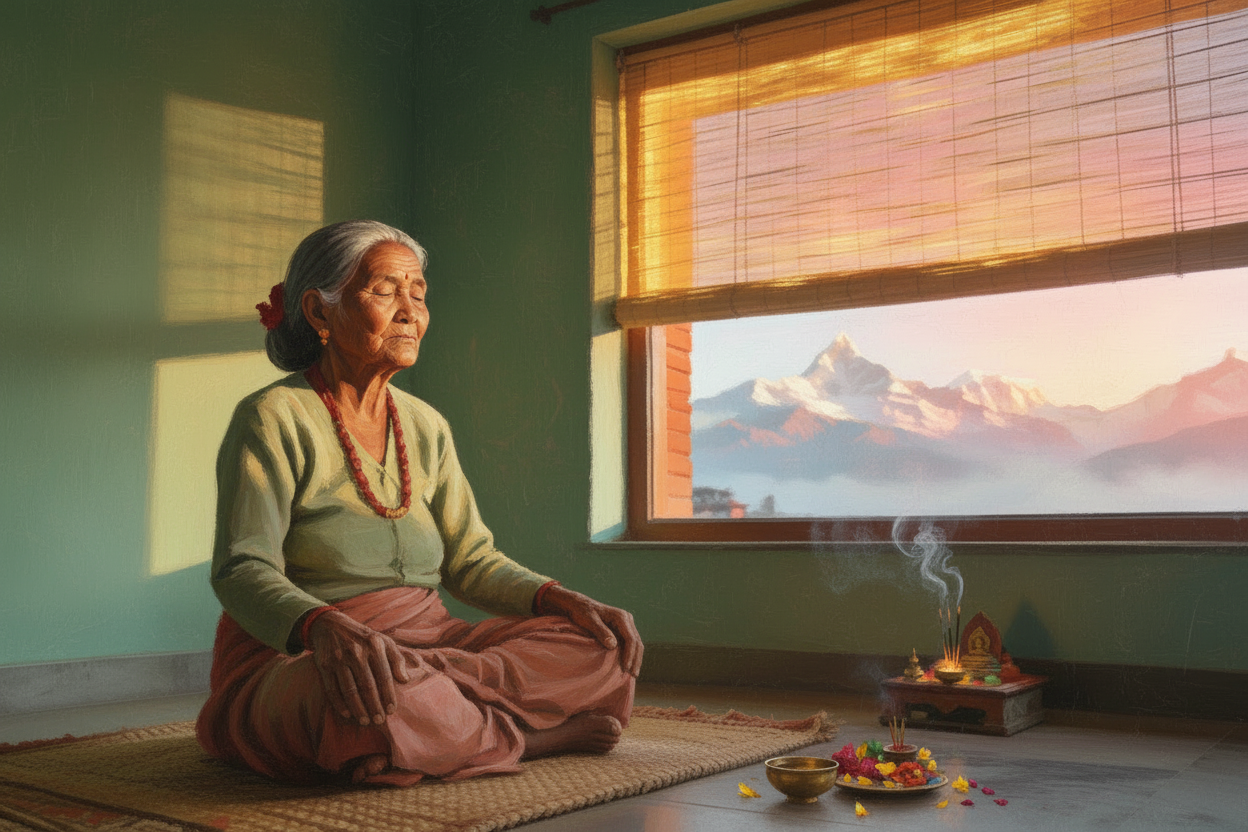
She was doing a body scan. She just did not call it that.
This ancient practice of turning inward is not new to Asia. In Nepal, we have always understood the connection between body, mind, and spirit, even if modern life makes us forget. The monks in the monasteries of Boudhanath practice meticulous awareness of physical sensations as part of their walking meditation. The sadhus by the Bagmati River cultivate profound sensitivity to bodily experience. And your own grandmother probably had her version of this wisdom, too.
Body scan meditation is not another imported wellness trend. It is returning home to a knowledge your body already holds. It's systematically and kindly paying attention to the map of your being, from the crown of your head to the soles of your feet. And whether you are sitting in a Kathmandu apartment or a village home, the science behind why this works is as compelling as the peace it brings.
The Asian Roots of Embodied Awareness
Forget the apps with synthesized sounds of Tibetan singing bowls. The true roots of body awareness run deep here. In Nepal, we don't separate the physical from the spiritual. Look at our traditional healing practices.
Dhami-Jhankri healers begin by "scanning" the patient's body with their hands, sensing energy blockages, temperature changes, and areas of tension. They're reading the body's story through sensation. Ayurvedic practitioners diagnose by pulse (Nadi Pariksha), listening to the subtle messages in the wrist. Your body speaks, if you know how to listen.
In Japan, they practice seated meditation. Here, the focus is deeply on your posture and how your body meets the cushion and the floor. Meanwhile, in Thailand's forest monasteries, monks train by contemplating the 32 parts of the body. It's a brave, honest scan of our physical form, a way to see the body clearly, as it truly is.
And in the heart of a Nepali home? Watch a mother preparing for puja. She washes her hands, touches her forehead, feels the rice grains between her fingers, and senses the weight of the water pot. She is fully in her body, present in each ritual action. This is embodied mindfulness. We've just stopped recognizing it in our daily lives.
So, when Jon Kabat-Zinn created the popular Mindfulness-Based Stress Reduction (MBSR) program in the 1970s, he wasn't really inventing something new. He was translating an old truth into a modern medical language.
For thousands of years, Asian meditation traditions have held a simple key: paying careful, step-by-step attention to the feelings in your body is a direct route to a clearer mind and a calmer heart. Kabat-Zinn took specific practices, like Burmese Vipassana, where you mentally scan your body with fine-tuned awareness, and framed them in a way doctors and hospitals could understand and use.
The beautiful part? This means our own grandmothers, sitting each morning to feel the stiffness in their backs or the rhythm of their breath, weren't just being traditional. They were practicing something science now confirms works. Their quiet "checking in" was valid medicine all along.
Why Your Body Needs You to Listen: Science Meets Tradition
Here's where ancient wisdom and modern neuroscience shake hands. This is not just "feel-good" philosophy. What happens in your brain during a body scan is measurable and profound.
Your brain has a region called the insula cortex. Think of it as your body's master dashboard. It's the primary site for interoception, your ability to sense what's happening inside you. It takes data from your nerves (your heart, your stomach, your tense shoulders) and translates it into feelings you recognize: anxiety, excitement, peace, pain.
When you spend months or years ignoring your body's signals, powering through headaches in Kathmandu's noisy streets, ignoring back pain from long public bus rides, suppressing stomach tension during difficult family conversations, this dashboard gets dusty. The gauges malfunction. You might misread "dehydration" as "anxiety," or "exhaustion" as "laziness."
A major 2022 study, which included people from Nepal, found something amazing. Regularly practicing mindfulness, especially the body scan, not only relaxes you; it physically strengthens a key part of your brain called the insula cortex. Think of it as upgrading your mind's own inner GPS for understanding your feelings.
On average, people in the study saw their anxiety symptoms drop by nearly one-third. For a country like ours, where talking about mental health is still hard and professional help is not always easy to find, this is big news. It means you have access to a powerful, proven tool for healing that doesn't cost a thing and starts with you.
Then there's the nervous system reset, crucial in our frequently messy environments. Your autonomic nervous system has two gears: sympathetic (fight-or-flight) and parasympathetic (rest-and-digest), necessary for actual survival. Many of us live in chronic low-grade sympathetic arousal. The gentle, non-judgmental attention of a body scan, the kind of attention your grandmother gave her morning breath, acts as a direct switch to safety. Your heart rate slows. Your breath deepens from your chest to your belly. Your digestion, often compromised by street food and stress, actually functions better.
For the everyday pain many of us live with, achy joints, constant headaches, there's a scientific reason the body scan helps. It's called the Gate Control Theory. The idea is simple: by giving your brain other, harmless sensations to focus on (like "my leg feels heavy" or "the fan's air is cool"), you can actually block some of the pain signals from getting through. You're gently closing a gate on the discomfort.
And what about sleep, which can feel impossible on a hot night with dogs barking outside? The body scan works here, too. It mixes gentle relaxation with focused attention. This stops you from trying to force yourself to sleep, which is usually the very thing that keeps you wide awake, staring at the ceiling in frustration.
The Unexpected Gifts (Beyond Stress Relief)
Everyone promises stress relief. And you'll get it. But for us, navigating specific Nepali and Asian contexts, the benefits run deeper.
First, emotional clarity in collective cultures.
We often prioritize family and social harmony over individual feelings. Sometimes, we don't even know what we feel. A body scan cuts through that. Is the tension in your throat (suppressed words to your parents)? The upset in your stomach (anxiety about that family obligation)? The heaviness in your chest (grief you haven't allowed yourself to feel)? Locating the feeling in your body makes it real, manageable information, not a vague cloud of "guilt" or "duty."
Second, better decision-making when choices are complex.
That gut feeling is real science; your enteric nervous system has more neurons than your spinal cord. Before saying "yes" to that job abroad, or agreeing to that arranged marriage meeting, or investing in that relative's business idea, do a quick scan. Is my stomach soft and open, or knotted and closed? Is my breath free, or held high in my chest? Your body often knows the truth before your brain calculates social expectations.
Third, a healthier relationship with your physical self.
We carry so many inherited ideas about our bodies, comments from aunties, Bollywood beauty standards, practical demands of physical labor. A body scan creates a neutral space. The instruction is not "my arms are too thin" or "my hips are too wide." It's simply: "Bring awareness to your right arm. What sensations are present? Warmth? A faint pulse? The texture of your sleeve?" It returns you to the experience of having a body, not judging one. In a culture of constant comparison, this is radical self-acceptance.
Finally, resilience in challenging environments.
The power cuts, pollution, crowded spaces, and bureaucratic hurdles take a toll. A daily body scan is like a systems check for your vehicle before navigating outside roads. You notice the tight shoulders from hunching against the cold, the headache from diesel fumes, the anxious breath before an exam. You can address these small tensions before they become breakdowns. Your body transforms from something that suffers the environment to something you actively care for within it.
How to Do It: A 10-Minute Guide for Real Life
You don't need a silent retreat. You can do this tonight, in your room, with the sounds of the city as your background.
The Setup:
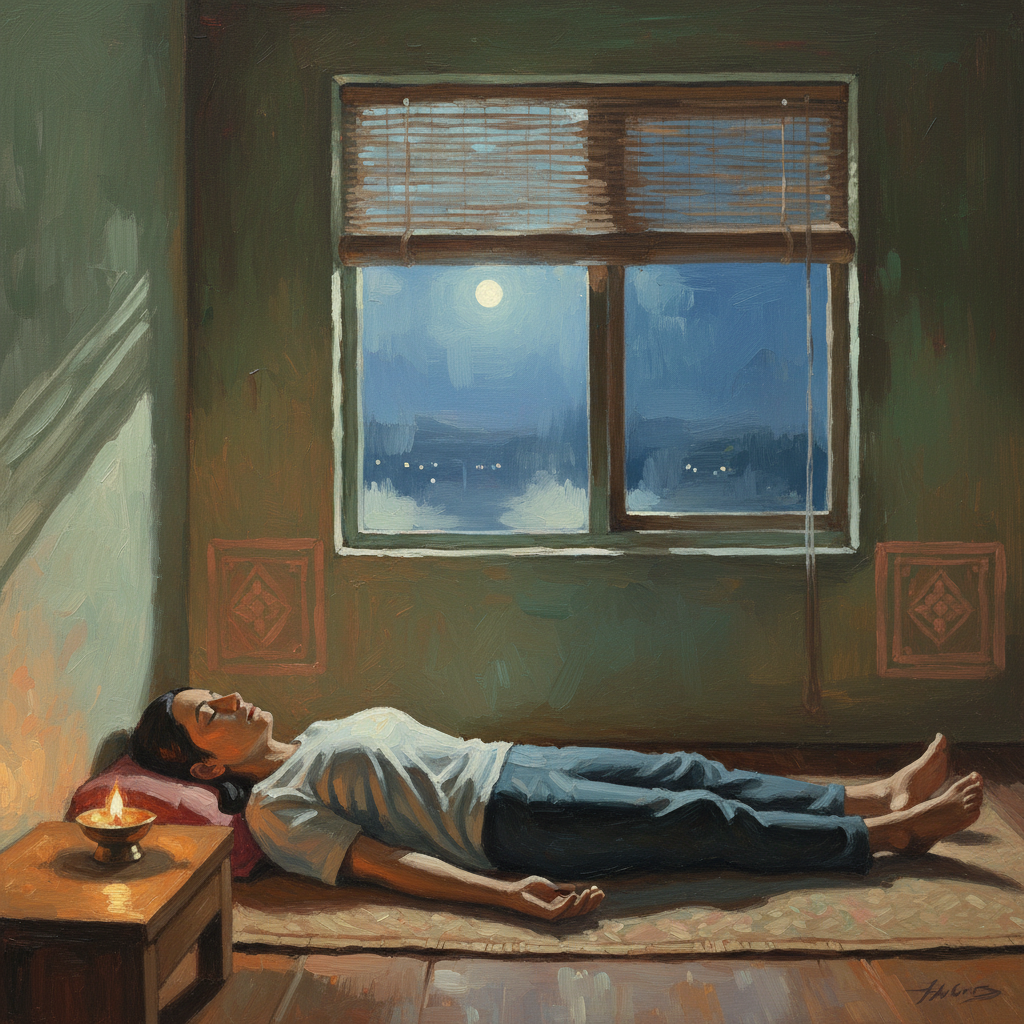
Find 10 minutes. If you have a private space, great. If not, find a corner. You can sit on the floor against a wall, cross-legged style, or lie on a mat or on a bed. Loosen your shirt. Turn your phone to silent, not vibrate. Let the sounds be there: the barking dogs, the distant temple bells, the neighbor's TV. They're part of your reality. Don't fight them.
The Practice:
Arrive.
Get comfortable, sitting or lying down. Take three deep breaths, like a big sigh at the end of a long day. Feel the air come in through your nose. Notice how it feels, is it cool? Dry? Just be aware of it.
Start at the feet.
Bring your focus to your right foot. Feel how it presses against the floor or your sandal. Is it warm? Cool? Do you feel any ache from walking on rough ground? Any pins and needles? Just notice. Then do the same with your left foot. Feel your connection to the ground beneath you.
Travel upward.
Now move your attention up. Your ankles may be sore from stairs or hills. Your calves. Your knees. Your thighs. Just observe each area. Many of us hold stress here from sitting or walking a lot.
The core.
Bring your focus to your hips and lower stomach. Feel your lower belly gently move in and out with each breath.
Now notice your ribs. Then your chest, does it feel tight or relaxed?
Finally, your upper back, that's where many of us carry our worries, like a heavy bag.
Arms and hands. Fingers that type, cook, and carry. Palms. Writs. Forearms. Elbows. Upper arms. Shoulders, where the weight of the world often lands. Consciously let them drop, just an inch.
Neck and head. Throat, where words get stuck. Jaw, so often clenched. Lips. Cheeks. Nose. Eyes, gently release the effort behind them. Forehead. The crown of your head.
The whole body. For a final minute, feel your entire body breathing as one. A complete, living being. Present. Here.
Gently return. Slowly open your eyes. Look around your room. You've traveled deep within, and now you return to the world. Move slowly as you rise.
Real-World Adjustments for Here:
Too noisy? Don't resist it. Notice the sound, then gently return to the sensation in your left knee. The practice is returning.
Too hot? Scan for the feeling of sweat on your skin, the breeze from the fan. Include it.
Too many people around? Do a "micro-scan" sitting in a chair. Feet on the floor, feel them. Scan up to the shoulders. Notice jaw. Unclench. One minute. Done.
Feel emotional? Perfect. We carry generations of unexpressed feelings. If touching a tense area releases tears or anger, breathe into that area. Say to yourself, "Ah, so this has been here." Let it be. Let it move.
Making It Yours: Integration into Daily Life
This practice becomes powerful when it stops being a "practice" and becomes a way of being. Here's how to weave it in:
Before your morning tea: Instead of immediately reaching for your phone, sit for three minutes and scan from head to heart. Set a different tone for the day.
In a taxi or public bus: Stuck in traffic? Scan your body. Notice the tension of gripping the seat. Consciously release it. Transform wasted time into healing time.
After family tension: Go to your room. Scan. Where did that argument settle in your body? Your tight stomach? Your buzzing head? Breathe into those places.
You don't need special equipment to start. A basic yoga mat helps mark your own quiet space. A cozy malashawl can work like a weighted blanket, just lay it over your shoulders for a comforting, heavy feeling, and the free Insight Timer app has guided body scan meditations you can listen to in any language as you prefer.
The Return Home
We are pulled in so many directions: family duties, career ambitions, cultural changes, and economic pressures. We can feel fragmented, stretched thin between tradition and modernity.
The body scan is an act of coming home. Not to a place, but to yourself. To the breath in your lungs, the pulse in your wrist, the ground under your feet. It's remembering that before you are a professional, a child, a parent, a citizen, you are a living, breathing, sensing being. And this being has wisdom.
Your grandmother knew this in her sunlit kitchen. The monk knows this in his silent gompa. And now, you can know it too, right in the middle of your beautifully complicated life.
So tonight, before you sleep, try it. Start with your left foot. And listen. Your body has been speaking in the dialect of sensation for your entire life. It's time to understand what it's saying.
Sometimes, even small things make all the difference.


Comments (0)
No comments yet. Be the first to comment!
Leave a Comment