
Table of Contents
The Power of Gratitude: Transforming Your Life (One Thought at a Time)
Look, I need to be honest with you. A few years ago, if you’d told me to “practice gratitude,” I’d have rolled my eyes so hard you’d have heard it. Gratitude? Please. That was for people with perfectly curated social media lives, for the morning journalers who had their lives together while I was chugging cold coffee, scrolling through bad news, and wondering why I felt so perpetually… frazzled.
My brain back then felt wired for worry. It would latch onto that one critical email, the awkward thing I said three days prior, the looming deadline, and just loop. Gratitude sounded like a spiritual Band-Aid, a Hallmark card solution to very real, modern problems. Like trying to put out a house fire with a gratitude journal.
But here’s the thing. I was desperate. And in that desperation, I tried it. Not the performative “I’m so grateful for everything” version, but something quieter. Something real.
What happened wasn’t a lightning bolt moment. It was more like a slow, gentle sunrise inside my own mind. And that shift, that subtle, profound rewiring, is what I want to share with you. Because genuine gratitude isn’t about forcing a smile. It’s a quiet, revolutionary act of neural rebellion. It’s how you build a lighthouse within yourself, so you can navigate any storm.
Gratitude as Your Brain’s Anti-Depressant
Okay, let’s get nerdy for a second, because this is where it gets wild. When you genuinely feel gratitude, and I mean really feel it, not just list it, your brain isn’t just having a nice thought. It’s throwing a chemical party.
I learned this after one particularly grim Tuesday. I’d spilled coffee on my keyboard, my train was delayed, and I was buzzing with that low-grade panic that feels like background music for adult life. In a moment of pure frustration, I looked at the sticky mess on my desk and, instead of cursing, muttered, “Well… thanks for the caffeine, I guess.” I even laughed a little at the absurdity.
And something physically shifted. My shoulders dropped. The tightness in my chest eased. It wasn’t magic; it was neurochemistry.
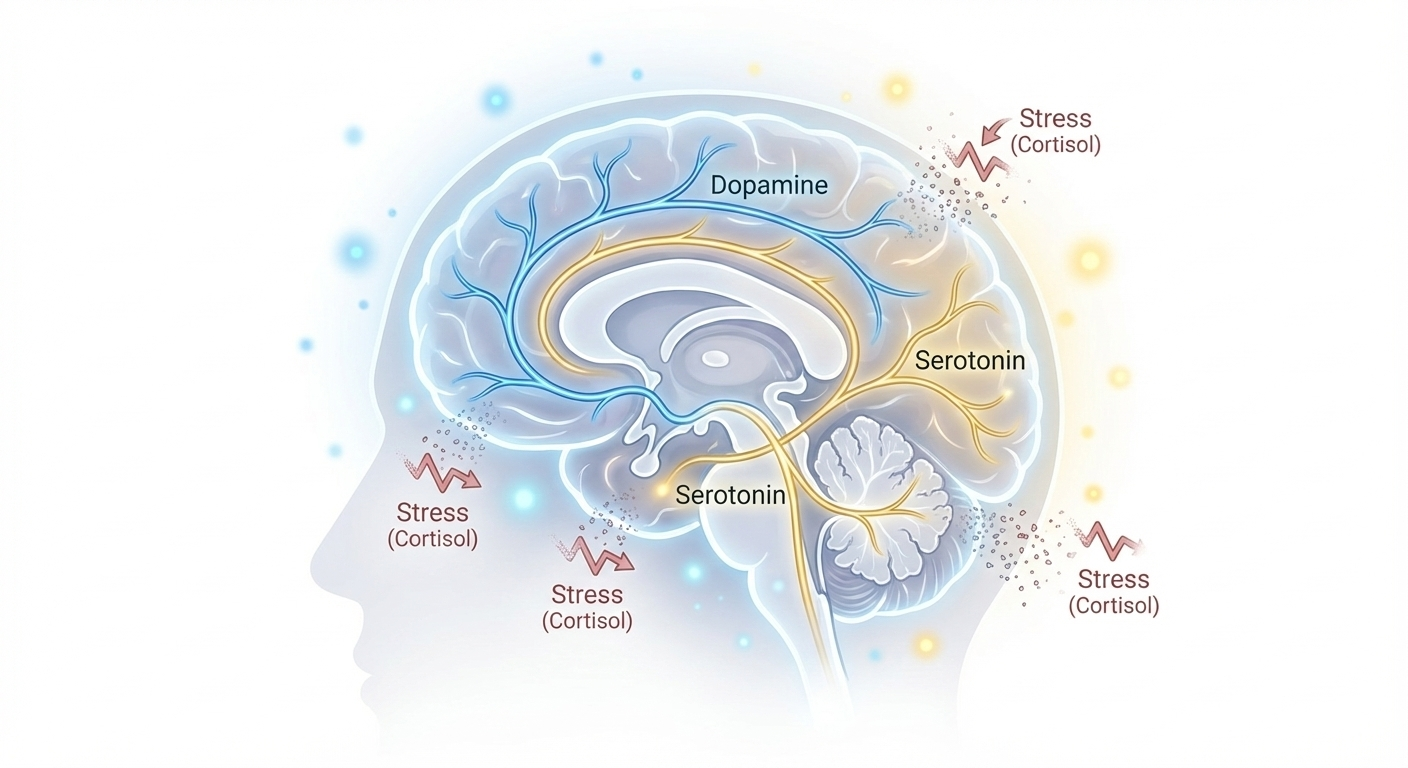
Here’s the simple science: focusing on something you appreciate boosts dopamine (your brain’s “reward” chemical) and serotonin (the key mood stabilizer). It literally feels good. At the same time, it tells your stress response to stand down, lowering cortisol. Even cooler, it activates your prefrontal cortex, the part of your brain responsible for good decisions and emotional regulation. You become less reactive.
Harvard Health has published studies showing that this stuff is real, consistent gratitude practice can change your brain’s structure over time. It’s like weightlifting for your capacity for joy.
This is why it’s such a powerful tool for calming your nervous system. It’s a direct counter-signal to the alarm bells. I started seeing it as less of a “spiritual practice” and more of a practical, biological hack for survival in a chaotic world. It’s the foundation for finding a sense of calm when everything feels like chaos, something I explore more in my guide on finding calm when the world feels loud.
The Modern Gratitude Trap (What Most People Get Wrong)
But here’s where we usually trip up. I did for years.
We confuse gratitude with toxic positivity, that forced, plastered-on smile that says “good vibes only” while you’re dying inside. That’s not gratitude; that’s spiritual bypassing. It’s saying “I’m so grateful for my job” through gritted teeth while you’re miserable. That disconnect just makes you feel worse.
Then there’s the checklist approach. “I’m grateful for my house, my cat, my health, my family…” It becomes another rote chore, like flossing. You do it because you’re supposed to, but your heart’s not in it. Your brain gets bored. It doesn’t land.
And the pressure! We think it has to be for something big, profound, and Instagram-worthy. A sunset. A promotion. A perfect relationship.
No wonder we quit.
The fix is embarrassingly simple, and I almost missed it: You have to feel it in your body. Gratitude isn’t an intellectual exercise. It’s a somatic experience. It’s the warmth that spreads through your chest when you hear your friend’s laugh. It’s the deep breath of relief when you finally sit down after a long day. It’s the tiny smile at the way the light hits your plant in the afternoon.
Stop listing. Start feeling. Start small. Thank the hot water in your shower. Thank your legs for carrying you. Thank the barista for actually getting your order right. Let the “thank you” land, just for three seconds.

Gratitude for the Digital Age: 3 Practices That Actually Stick
So how do we do this when our attention is pulled in a million directions? We need practices built for modern, distracted, tired brains. Not another lengthy journaling session. These are the three that changed everything for me.
1. The Moment Grabber (Using Your Phone For Good)
We’re always reaching for our phones to capture something. Let’s hack that instinct. Your mission: once a day, use your camera to “grab” a moment of simple, unexpected beauty. Not for the ‘gram. For you.
It could be the weird, beautiful shadow your coffee mug makes. The chaotic art of your kid’s toys on the floor. The way the rain looks on your window. Snap it. Look at the photo for five seconds. Think or whisper, “Thanks for that.” That’s it. You’ve just hijacked your scroll reflex and pointed it toward awe.
2. Relief Acknowledgement (The Anxiety Antidote)
This one is my secret weapon. We’re great at worrying about what might go wrong. How about giving thanks for what didn’t?
“I’m so grateful that the meeting got canceled.”
“Thank goodness that weird noise in my car was nothing serious.”
“I’m so relieved I didn’t send that angry text I drafted.”
This practice directly targets the catastrophic “what-if” center of your brain. It acknowledges the near-misses, the bullets dodged, the small reprieves. It turns anxiety’s fuel into gratitude’s kindling.
3. The Difficult Blessing Reframe
This is the advanced class, and it’s where real transformation lives. It’s not about being grateful for the hard thing. It’s about finding the tiny seed of growth or clarity within it.
That brutal argument? It showed you exactly where you need to set a firmer boundary. That project that failed? It taught you what doesn’t work, clearing the path for what might. That period of loneliness? It forced you to learn how to be with yourself.
This isn’t sugar-coating. It’s alchemy. It’s how we stop being victims of our circumstances and become students of our lives. It’s deeply connected to the work of integrating our shadows, which I talk about in my piece on finding the lessons hidden in our challenges.
To help me with this, especially understanding the why behind the how, I leaned on books like The Upward Spiral by Alex Korb. He breaks down the neuroscience of practices like this in a way that makes me feel like I was learning to operate my own brain. (It’s an affiliate link, meaning I get a small commission if you buy it, but I’m recommending it because I have worn out my copy with re-reading.)
The Transformation in Action: What Actually Shifts
When you commit to this, not perfectly, but consistently, the ripples spread out in ways you don’t expect.
I noticed it first in my relationships. I’d be talking to someone and find myself silently thinking, “I’m so grateful for their sense of humor,” or “I’m really thankful they trust me with this.” It changed my energy. I listened better. I was less reactive. The connection deepened without me doing anything but thinking a thankful thought.
My resilience changed. On a hard day, I now have a “gratitude bank” I can draw from. It’s not Pollyanna-ish; it’s strategic. I can remember, “Okay, but remember how the sun felt on your face yesterday? Remember that stupid joke that made you snort-laugh?” It doesn’t erase the pain, but it sits beside it and says, “This isn’t the whole story.”
And opportunities? They started showing up more. This sounds like “law of attraction” fluff, but it’s actually brain science. You have a filter in your brain called the reticular activating system (RAS). It decides what you notice. If your RAS is tuned to “lack and danger,” that’s all you’ll see; there are more reasons to be stressed. If you tune it to “appreciation and beauty” through gratitude, it starts pointing those out to you. You notice the “help wanted” sign, the kind stranger, the new idea. You create your own positive feedback loop.
Curious about more of the brain science behind this feedback loop? The Upward Spiral was truly a game-changer in connecting the dots between my daily practice and the tangible shifts in my mood and outlook.
Your No-Guilt, 7-Day Gratitude Reset
Think of this as your personal, private experiment. No downloads, no sign-ups, no extra steps. Just you and your noticing.
Feeling curious? Let’s run a tiny experiment together. No journals to buy, no 30-minute commitments.
For the next seven nights, right as you’re settling into bed, phone away, lights low, ask yourself one quiet question:
“What surprised me with joy today?”
It doesn’t have to be big. It doesn’t have to be deep. It might be:
- The way the afternoon light hit your desk.
- That text from a friend that made you chuckle.
- The first sip of your drink, hot or cold, exactly as you like it.
- The quiet moment when the house was finally still.
Here’s what I do: I keep a simple notebook on my nightstand. It’s not fancy, it’s actually a beat-up, half-used journal with grocery lists on some pages. Every night, I write down that one thing. Sometimes it’s just three words: “socks still warm.” Sometimes it’s a sentence. The act of writing it down, pen to paper, seals it in. It tells my brain, This mattered enough to record.
If a notebook feels like too much, use your phone’s notes app. Or just whisper it to the dark room before you close your eyes. The medium doesn’t matter. The noticing does.
The goal isn’t to create a masterpiece of prose. It’s to build the muscle of attention. To train your mind to scan the clutter of the day and find, like a treasure hunter, the one gleaming little shard of “thank you.”
Try it. Seven days. One sentence, one phrase, one word each night.
Then, if you feel like sharing, I’d genuinely love to hear what shifted for you. Drop your first “surprise joy” in the comments below. Sometimes, reading what sparked joy for someone else sparks a little more in us, too. We’re in this practice together.

Conclusion
Gratitude, in its truest, deepest sense, isn’t about ignoring the darkness. It’s not a spiritual bypass. It’s the deliberate, courageous act of building a light within you so bright and steady that you can see clearly, no matter how dark it gets outside. It’s how you transform your life, not by changing every circumstance, but by changing the one thing you truly have control over: where you place your attention.
Your next breath is a fresh chance to start. What will you notice?



Comments (0)
No comments yet. Be the first to comment!
Leave a Comment