
Table of Contents
The Healing Hug: A 10-Minute Meditation to Comfort Your Younger Self (2026)
Have you ever reacted with 8-year-old anger to a 30-year-old problem?
Closed your eyes to meditate, only to feel that familiar chest knot—the one that doesn't belong to your adult life? The one that tightens when your partner raises their voice, even slightly? The one that clenches when you're left out of a group chat, a meeting, a moment?
That's not a distraction. That's your younger self, sitting quietly in the corner of your nervous system, waiting.
I know because I've felt her too. For years, I thought meditation was about quieting the mind. I'd sit, breathe, and try to think my way out of the tightness. But the tightness wouldn't leave. It would shift, maybe, from my chest to my throat, from my throat to my belly, but it never truly dissolved.
Then, one evening in early 2026, after a day of back-to-back Zoom calls and doomscrolling through yet another news cycle, I sat down on my cushion and something cracked open. Not dramatically. Not with fireworks. But with a single, whispered thought:
"I'm still here."
The voice wasn't mine, not my adult voice. It was smaller, younger, wearing a blue dress I'd forgotten I owned. And she wasn't asking me to fix her. She was asking me to see her.
What followed changed my practice forever. And today, I'm going to walk you through the exact 10-minute meditation that brought us together, the one that can bring you together with the child still living in your bones.
Where Your Younger Self Actually Lives: The Somatic Map of Childhood Wounds
Here's what 2026 is teaching us: childhood wounds aren't memories. They're biological echoes, stored tension patterns that live in your body, activated by present stress like a tripwire you forgot you laid.
The wellness world has spent the last few years obsessed with nervous system regulation for good reason. We're overstimulated, under-touched, and walking around with nervous systems that think we're still in the situations that scared us at six, ten, and fourteen.
Somatic Experiencing, the body-based therapy developed by Peter Levine, shows us that unprocessed trauma doesn't live in your narrative recall. It lives in your tissue. And in 2026, with digital stimulation at an all-time high and nervous systems running on empty, those tissue memories are humming louder than ever.
Here's what that looks like in practice:
- Chest tightness
• Younger self wound: Abandonment fear
• Adult trigger: Relationship stress, partner withdrawing - Clenched jaw
• Younger self wound: "Don't speak."
• Adult trigger: Authority figures, confrontation - Solar plexus knot
• Younger self wound: Boundary violation
• Adult trigger: People-pleasing, saying yes when you mean no - Throat lump
• Younger self wound: Swallowed grief
• Adult trigger: Vulnerability, tears, being seen - Shoulder tension
• Younger self wound: Carrying too much
• Adult trigger: Work overload, caregiving -
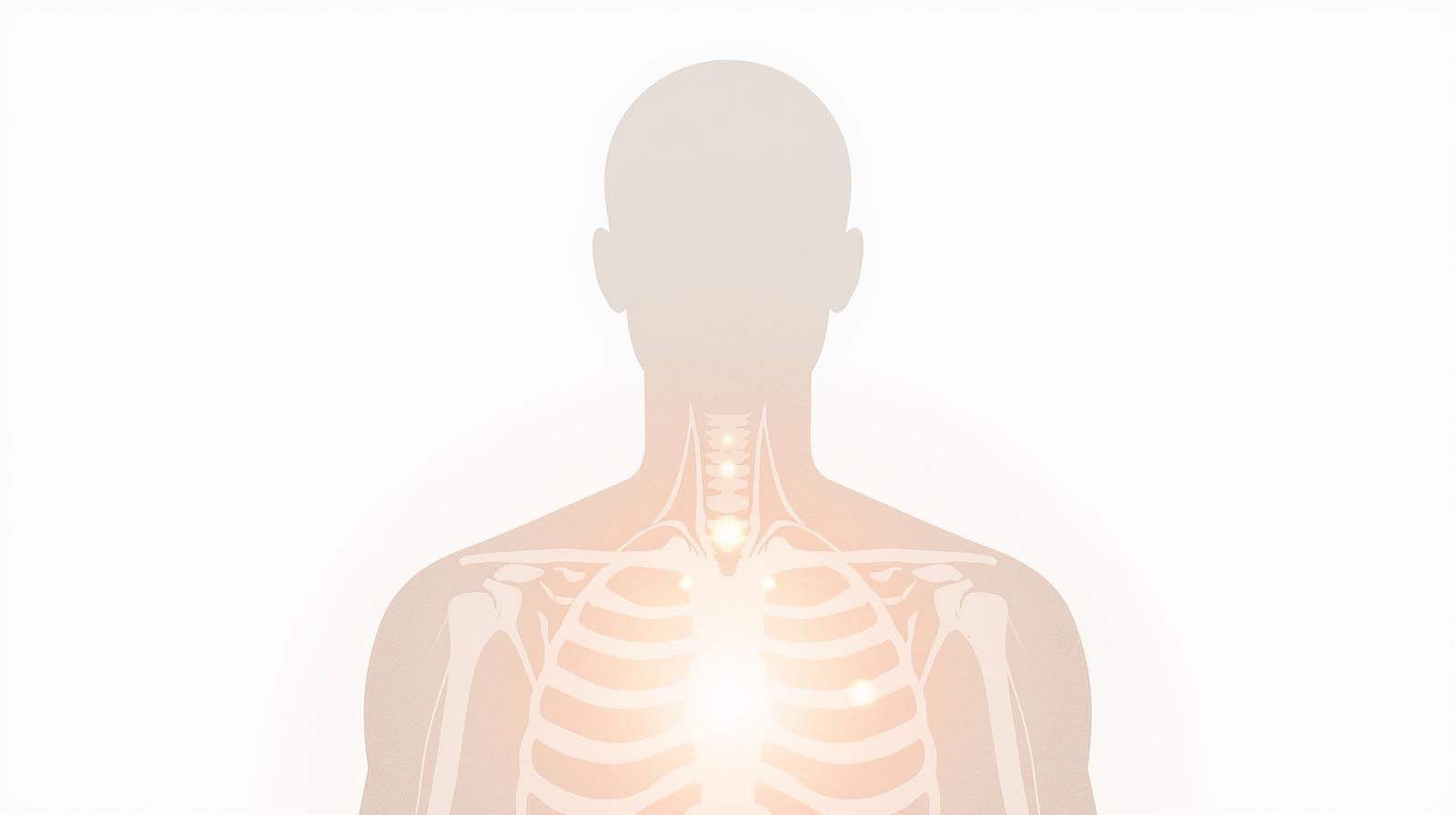
A silhouette of a human body with highlighted areas: chest, jaw, solar plexus, throat, and shoulders.
The mechanism? Your amygdala, that almond-shaped threat detector in your brain, hijacks your system faster than your prefrontal cortex (your adult reasoning center) can catch up. Research from Insight Timer's neuroscience team shows that consistent meditation can shrink this threat response by up to 22%. But here's the catch: you can't think your way out of a body-based wound. You have to meet it where it lives.
Your younger self isn't "unhealed." She's not broken, not a problem to solve. She's protecting you, with everything she has, until you're ready to hold her.
And you're ready now.
Creating Your Nervous System Sanctuary: The 2026 Meditation Container
Before we begin, let's talk about where this meeting will take place. In 2026, we're not just meditating, we're creating nervous system safety. Your younger self won't show up if she doesn't feel safe. Would you?
Physical safety signals:
I've learned that certain objects speak directly to the body's threat-detection system. These aren't luxuries, they're communication tools for your nervous system:
- Weighted anxiety blanket across your lap* – Deep pressure stimulation mimics the nurturing hold your younger self needed. It says: You're contained. You're held. You're not floating away.
- Organic lavender eye pillow* – Darkness + scent = sensory shutdown. This tells your visual cortex: Nothing to scan for danger. Rest now.
- Himalayan salt lamp* – That warm, dim glow isn't aesthetic, it's ancestral. Firelight meant safety. Your nervous system remembers.
(Full disclosure: these are affiliate links from my own practice. I use them daily.)
Digital boundaries (non-negotiable in 2026):
- Phone OFF. Not silent. OFF. Your younger self can feel the difference between airplane mode and truly disconnected.
- Set a 12-minute timer, not 10. Give yourself two minutes to arrive without clock-watching anxiety.
- Door closed. If you live with others, put a sign: In session with my younger self. Do not disturb.
Pro tip: Keep the Inner Child Journal nearby. After this meditation, your younger self will want to talk. Capture what she says before your adult mind edits it.

How Do I Talk to My Younger Self in Meditation? (The 10-Minute Practice)
This is the moment. The meeting. Let's walk through it together, minute by minute. If you can, read this section once through, then come back and do it. Let the words become your guide.
Phase 1: Anchor (Minutes 1-2)
Settle into your sanctuary space. Feel the weight of the blanket across your lap. Notice the dim glow, the lavender scent softening the edges of the room.
Close your eyes.
Breathe in through your nose for 4 counts. Hold for 7. Breathe out through your mouth for 8.
Again. In 2, 3, 4. Hold, 2, 3, 4, 5, 6, 7. Out, 2, 3, 4, 5, 6, 7, 8.
Feel your adult body in this chair, this cushion, this floor. Held by gravity. Supported by the earth beneath you.
You are safe now. You are here now. No one needs anything from you in this moment.
Phase 2: The Safe Room (Minutes 2-4)
Now, in your mind's eye, begin to build a place of complete safety.
It can be anywhere. A meadow filled with wildflowers, warm sun on your skin. A childhood porch swing, creaking gently in summer air. A library of golden light, shelves holding only kindness.
See the floor beneath you. Feel its texture—wood, grass, stone, cloud.
Notice the light. Where is it coming from? Warm, soft, golden.
Feel the air—warm, cool, still, moving gently.
This place is yours. No one enters without your permission. Nothing here can hurt you.
Stay here for a moment. Let your body absorb this safety. Lingering here isn't wasting time; it's building the container your younger self needs.
Phase 3: The Meeting (Minutes 4-7)
Now, from this place of safety, softly invite your younger self to appear.
Don't search for her. Don't force it. Simply open your heart and whisper: "I'm here. You can come if you want."
She might peek from behind a tree, eyes downcast, arms crossed. She might be very small, too small to speak. She might be hiding, or she might run straight into your arms.
Perfect. Let her come exactly as she is.
Notice her size. How old does she look?
Notice her clothes. What is she wearing? A favorite dress? Hand-me-downs? Pajamas?
Notice her expression. Is she scared? Angry? Tired? Defiant?
Don't change anything. Don't fix anything. Just breathe with her.
Feel your breath moving in your chest. Know that with each breath, you're sending her a message: "I'm still here. I'm not leaving."
This is the crucial moment. Many of us want to rush in and hug her. But shy children need distance first. Let her approach you.

Phase 4: Reparenting Dialogue (Minutes 7-9)
When she's ready, when you feel the slightest softening, begin to speak to her. Not with your mouth. With your heart.
You can say:
- "I am here now. You don't have to be strong anymore."
- "I see how scared you felt. I'm so sorry I wasn't there."
- "You can rest now. I've got this."
- "Your feelings are always welcome here. Always."
- "You didn't do anything wrong. You were just a child."
- "I love you. Not the person you thought you had to become. YOU. Exactly as you are."
Say whichever words rise from your chest. Let them be simple. Children don't need poetry; they need truth.
Now pause. Let her respond.
She might speak. She might show you a memory. She might just lean closer, or look up at you for the first time.
Whatever comes, receive it. Don't judge it. Don't analyze it. Just let it be.
If she wants a hug, hold her. If she wants distance, respect that. You're building trust, not forcing a connection.
Phase 5: Integration (Minutes 9-10)
Slowly, gently, begin to return your awareness to this room.
Place one hand on your heart, one on your belly.
Feel the warmth of your hands. Feel the thread connecting past-you, present-you, future-you, all of you, held in this single breath.
When you're ready, wiggle your fingers. Wiggle your toes. Take a deeper breath in.
Open your eyes when you choose.
Welcome back.
What Happens After She Appears: Post-Meditation Integration
The meditation doesn't end when you open your eyes. In many ways, it's just beginning.
Body signals that she's settling:
After this practice, watch for:
- Chest softening, as if something released its grip
- Tears flowing freely, not sad tears, release tears
- Spontaneous smiles, unprompted
- Deep yawns, sighs, stretches
- A sudden craving for comfort, tea, warmth, soft blankets
These are all signs that your nervous system is integrating the experience. Your younger self is finally being heard.
Journal immediately:
Before your adult mind swoops in to interpret, capture what happened:
- What age was she?
- What was her posture, her expression?
- What did she need you to know?
- What was the one word she needed to hear most?
Write it down exactly as it came. No editing. No analyzing. Just witness.
The science behind it:
This isn't just spiritual woo, it's attachment science. Tara Brach's work on Radical Compassion shows that meeting our wounded parts with unconditional friendliness rewires neural pathways. The Gottman Institute's research confirms that reparenting affirmations literally reshape our attachment circuits, even in adulthood.
Your brain is plastic. Your nervous system can learn new patterns. And your younger self can learn, finally, that she's safe.
Daily practice:
Ten minutes before bed. That's all it takes. Your younger self sleeps better when she's been held. And so do you.
What 30 Days Does: The Radical Peace of Being Held
In my own journey, three weeks of this practice transformed something fundamental. The chest-tight meditation I'd endured for years became a heart-open presence. The scared 6-year-old in the blue dress stopped hiding behind trees and started running toward me.
Not because I fixed her. Because I showed up.
Your younger self isn't asking for perfection. She's not asking you to have all the answers, to undo the past, to become someone you're not.
She's asking for your attention. Your presence. Your willingness to sit in the dark with her and whisper, "I'm here. I'm not leaving."
That's the healing hug. Not a fix. A holding.
Your 30-day invitation:
- ✅ 10 minutes daily, same time, same space
- ✅ Weighted blanket, dim light, phone off
- ✅ Journal her messages immediately after
- ✅ Notice what shifts—in your body, your reactions, your relationships
Continue your path:
- Shadow Work for Spiritual Growth
- Building Resilience: Bouncing Back from Life's Challenges
- Breath Awareness: Your Simple Anchor to the Present
Your younger self has been waiting a long time. She's not going anywhere. But tonight, for the first time, she might finally rest.
See you on the cushion.
All product links are affiliate links. I only recommend what I use in my own practice. Your purchase supports Spiritual Nomad at no extra cost to you.



Comments (0)
No comments yet. Be the first to comment!
Leave a Comment