
Table of Contents
Transforming Limiting Beliefs: A Nepali and Asian Mindset Guide
Have you ever felt a sinking feeling just as you are about to apply for a job abroad, start your own venture, or finally say "no" to a family obligation to pursue your own path? That voice that whispers, Only men do this kind of work, A person from a small village can not achieve much, or Money comes only with hardship? That, my friend, is not just nerves; it is a limiting belief running the show, quietly dictating your choices and capping your potential.
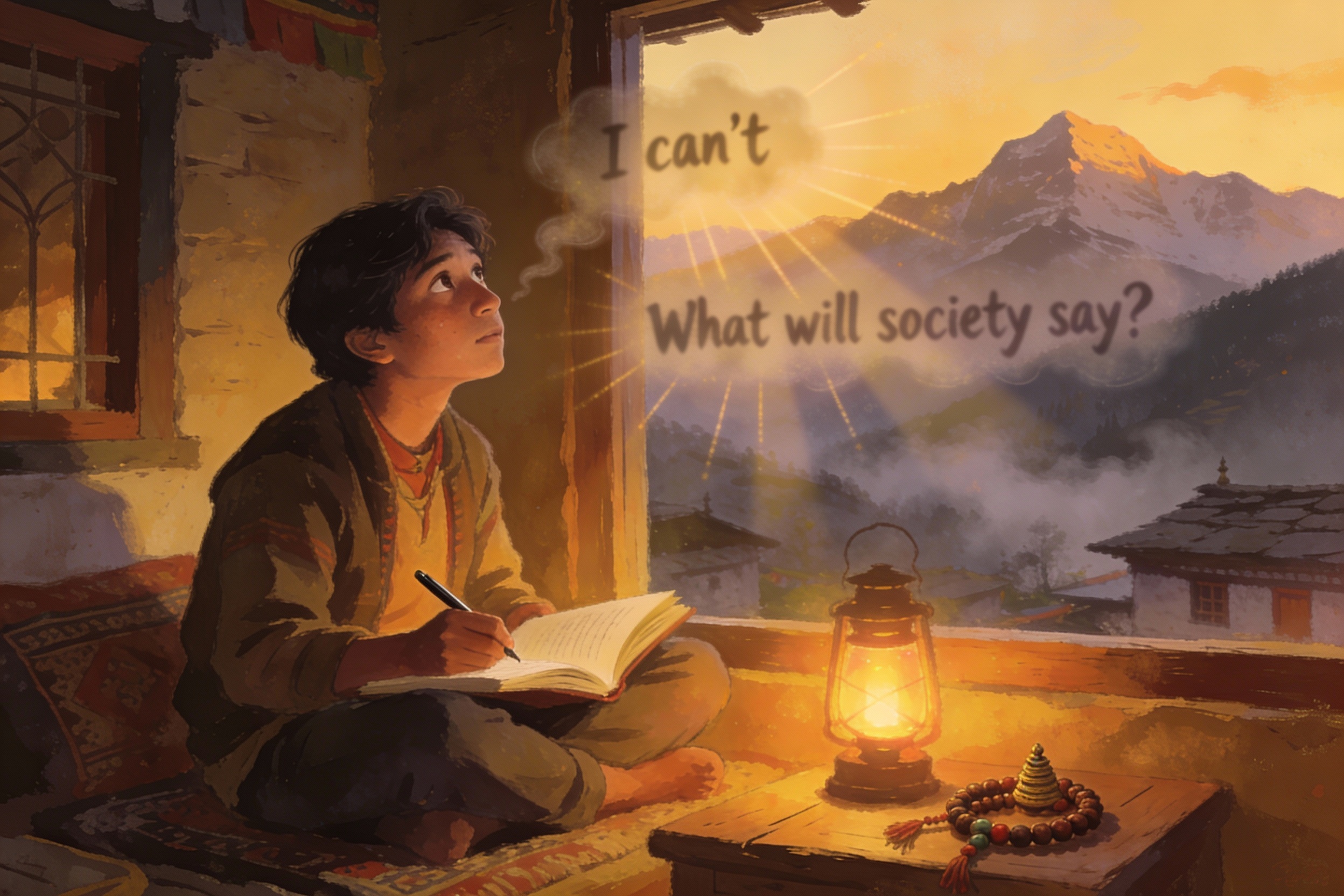
Limiting beliefs are the deep-seated assumptions we hold about ourselves, others, and the world that operate like invisible rules. In our Asian and Nepali context, they often sound like: A government job is the only secure path, I am too old to learn now, or What will society say?. The impact is profound. These beliefs can stifle ambition, keep us in unfulfilling roles, strain our mental health, and keep genuine happiness just out of reach.
But here is the liberating truth: Your beliefs are not permanent fixtures. They are learned software, and you have the power to rewrite the code. This guide is your science-backed, compassionate roadmap for transforming limiting beliefs from roadblocks into stepping stones. I will walk you through a clear, multi-step process, from detection to deep integration, complete with exercises, tools, and a free Limiting Beliefs Workbook to support your journey. Let's begin the work of uncovering and upgrading the beliefs that no longer serve you.
Section 1: The Root of the Problem, Understanding Your Mental Software
Where Do Limiting Beliefs Come From? (Family, Society, Trauma, Repetition)
Before we can transform something, we must understand its origin. Limiting beliefs do not come with us from birth; they are absorbed, learned, and reinforced over time.
Think of your young mind as a sponge, soaking up messages and beliefs from your environment:
- Family and Upbringing: Well-meaning but fear-based advice, like, "What will you do by studying arts? Become a doctor or engineer," or comparisons with siblings can harden into core identities ("I am not the smart one").
- Societal and Cultural Narratives: The weight of society, the stigma around mental health, the pressure for early marriage, or the idea that suffering is a virtue - "Life is not meant to be easy," become our unconscious scripts.
- Past Failures and Collective Trauma: Not passing the school-level exam, a business loss during political instability, or the emotional toll of migration for work can crystallize into beliefs like "My luck is just bad" or "One must not take risks."
- Repetition: This is what makes them stick. When a thought is fueled by feeling and repeated over and over, it carves a mental rut. The more we use that path, thinking 'My English is poor' or 'I’m not confident', the deeper and more automatic that belief becomes.
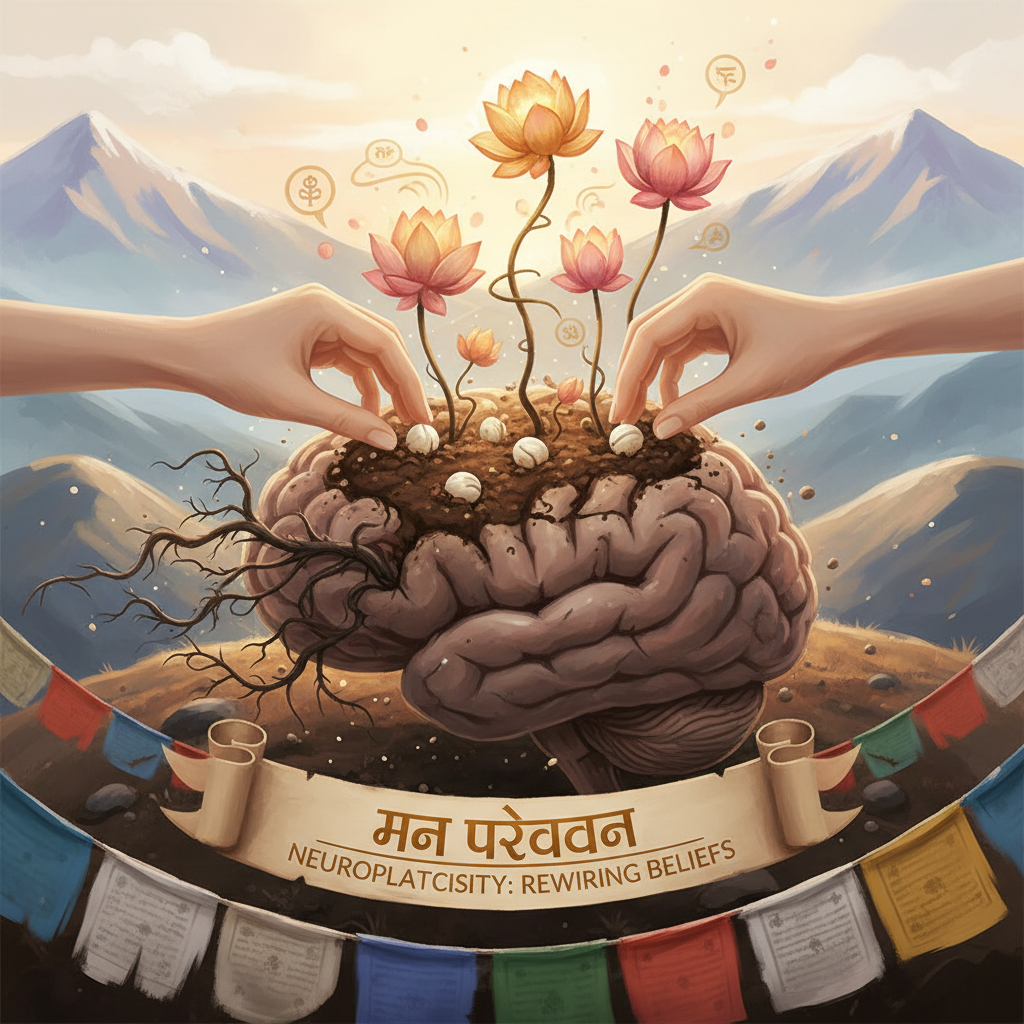
This brings us to the most hopeful scientific concept for anyone wanting to change: neuroplasticity.
For decades, we thought the adult brain was largely fixed. We now know the brain is malleable; it can reorganize and form new neural connections throughout life. When you learn a new skill (like a new language or a traditional instrument) or consistently practice a new thought pattern, you are literally rewiring your brain. The old, limiting belief pathway weakens from disuse, and a new, empowering pathway strengthens. This is not mystical thinking; it is neuroscience, backed by research from sources like the National Institutes of Health.
Analogy Time: Picture your mind as a lush garden. Your conscious thoughts are the plants you tend daily. Your subconscious beliefs are the soil. Limiting beliefs are like invasive weeds and old, tangled roots deep in that soil, secretly choking the growth of the beautiful plants above. You can not prune the leaves (change surface behavior); you must get into the soil and do the work of transforming limiting beliefs at the root level.
Want to understand your own mind better? Start by learning the difference between a fixed and a growth mindset. For the classic book on the topic, I always recommend Carol Dweck’s Mindset. It shows exactly how our beliefs about ourselves shape everything we do.
Section 2: The Detection Phase, Shining a Light on Your Hidden Beliefs
How to Identify Your Limiting Beliefs (The 4-Step Audit)
You can not fix a problem you do not know is there. Your first job is to shine a light on these hidden beliefs and bring them into full view. Think of this not as judging yourself, but as being a gentle and curious detective.
Let's run a 4-Step Audit with local context:
1. Listen to Your Language.
Your words are direct windows into your subconscious beliefs. Start noticing your automatic phrases:
- I can not do freelancing.
- Those living abroad have forgotten their culture.
- This is not for me.
Capture these phrases. They are your first clues.
2. Follow the Emotional Breadcrumbs
Your biggest emotional reactions are clues. For example, that sharp jealousy when a friend succeeds abroad, what does it say about what you believe is possible for you? Or the dread before a family event, what old story about your place or duty is it touching?
3. Examine Your 'Stuck' Areas
Check the areas that always frustrate you:
- Money: Do you undercharge because you think “Nepali customers won’t pay more”?
- Work: Do you stay in a bad job believing “There’s no other safe option”?
- People: Do you avoid saying no, worried you will look “too proud” or “too Western”?
For each, ask: “What belief must I have for this to keep happening?”
4. The Sentence Completion Exercise
Set a 5-minute timer and complete these quickly:
- Money is...
- Successful people are...
- Family is...
- I am...
- Taking risks is...
Reflect: Your instant answers reveal raw, underlying beliefs. Sit with them for a moment. Which one feels most charged or limiting? That’s where to focus your work from the previous sections.
Section 3: The Interrogation, Questioning the Evidence
Is This Belief Actually True? (The Courtroom Exercise)
Let's put a common South Asian belief to the test: A stable career means only a government job.
Grab your journal and answer:
- Evidence FOR this belief? "My parents say so. Many friends are striving for it. Private jobs can be insecure."
- CONCRETE evidence AGAINST it? "I know people in tech, freelancing, and entrepreneurship with stable, thriving careers. The global digital economy offers remote opportunities. 'Stability' now also means mental peace and growth, which my current job does not provide."
- Where did I first learn this? "From my family and teachers growing up in the 90s, when options were minimal."
- How did this 'protect' me? "It aimed to protect me from financial risk and social disapproval."
- What is it costing me NOW? "My passion, my potential for higher income, and my mental well-being in a job I dislike."
This journaling process comes from a well-known technique called Cognitive Behavioral Therapy (CBT). To learn more about the basics of CBT, you can explore this excellent guide from Verywell Mind, a respected health website.
Section 4: The Transformation Core – Rewriting Your Narrative
Crafting Empowering Beliefs That Stick
Use This Simple Formula:
- Old Belief: “A stable career means only a government job.”
- Evidence Against It: "The world of work has changed. I can create stability through my skills, adaptability, and multiple income streams."
- New Belief: "I am capable of creating a stable, prosperous, and fulfilling career on my own terms."
The 4 Keys to an Effective New Belief: It must be Positive, Personal, Believable, and Emotionally Charged.
Repeating your new belief is like doing reps for your brain. Visualization, imagining yourself thriving in a flexible career, strengthens the new pathway.
To support this practice, I recommend using a dedicated journal. The physical act of writing reinforces new neural pathways. A high-quality journal like this Beautiful Leather-Bound Journal can become a sacred space for your work. For guided visualizations, apps like Calm or Headspace are excellent, but you can also start with free practices on our site, like our Guided Meditation for Self-Belief.
Section 5: Embodiment & Integration – Making It Real
Taking Action Aligned with Your New Belief
Insight without action is just entertainment. You must embody the new story using the "As If" Principle.
From Belief to Micro-Action for Nepal/Asia:
- New Belief: "My creative skills have value in the global market."
Micro-Action: Create one profile on a global freelancing platform (Upwork, Fiverr) today. Just fill it out 50%. - New Belief: "I respect my needs without guilt."
Micro-Action: Politely decline one request this week that drains your energy, and use that time for self-care.
Keep an "Evidence Log": This is a game-changer. Write down every small win:
- "Posted my digital art online."
- "Said 'no' to extra work and went for a walk. Felt guilty but also powerful."
Section 6: Advanced Tools and Sustained Practice
Going Deeper: EFT Tapping, Hypnosis, and Community
For beliefs tied to deep cultural or family trauma, consider these:
- EFT (Emotional Freedom Techniques) / Tapping: Excellent for releasing the emotional charge of beliefs learned from a strict upbringing. A great book to start with is The Tapping Solution by Nick Ortner.
- Guided Hypnosis: Helps bypass the critical mind. Look for sessions focused on "confidence" or "releasing ancestral patterns."
- The Power of Community: Doing this work in isolation is hard. Consider joining a supportive community like our Spiritual Nomad Circle, where we navigate these unique cultural crossroads together.
Sometimes, personalized guidance is the fastest path. If you are feeling stuck, consider 1-on-1 Mindset Coaching for a tailored roadmap.




Comments (0)
No comments yet. Be the first to comment!
Leave a Comment