
Table of Contents
Overcoming Meditation Obstacles
You know that feeling, you sit, close your eyes, and within seconds you're replaying an argument, planning holidays, or wondering if you left the laundry in, and so many more things. The idea of meditating every day sounds inspiring... until your brain runs its own marathon. You're not failing. You're not "bad at meditation." You're just human. And in our fast-paced, noisy world, trying to find stillness can feel like trying to hear a whisper in a hurricane.
I get it. I've lost count of the sessions I spent mentally writing grocery lists instead of watching my breath. I've felt the frustration of "wasting" time I could have been "productive." That tug-of-war between the peaceful ideal and our chaotic reality is where most of us live. Here's the gentle truth we need to hear: every distraction, every doubt, every time you have to guide yourself back, that is the practice.
Meditation isn't about emptying your mind or finding perfection. It's about getting to know your own thoughts with kindness and consistency.
This guide will help you understand why sitting still can feel so difficult, tackle the five biggest hurdles people face today, and provide you with practical steps to overcome them. Let's transform mindfulness from a nice idea into a simple, daily habit that works for your real life.
Why We Face Meditation Obstacles: The Science of the Struggle
Before we tackle the "how," let's understand the "why." If your mind feels like a browser with 100 tabs open the moment you try to be still, there's a brilliant, biological reason for it. It's not a personal flaw.
First, meet your brain's autopilot. This is the part that creates daydreams, replays memories, and plans for the future when you're not focusing on a specific task. When you sit to meditate, you're telling this natural chatterbox to quiet down. Since its main job is to think, it resists. The thoughts you notice during meditation aren't a sign you're failing; they're just proof your brain is working as it should.
Then, there's the pressure always to be productive. We're taught that our value comes from what we do. So when you sit still to meditate, it can feel like you're being lazy or wasting time. That voice in your head saying, "You should be doing something useful right now," is hard to ignore. This makes meditation feel like a guilty break instead of the important practice it is.
Finally, there's Neuroplasticity, your brain's ability to rewire itself. Every time you notice a distraction and gently return to your breath, you're forging a new neural pathway. It's like carving a walking trail through dense forest. The first few times are tough, overgrown, and easy to lose. But with repetition, the path becomes clear and easy to follow. The "failure" isn't the distraction; it's the noticing and returning that builds the skill. As a Harvard study on meditation and the brain showed, consistent practice physically changes brain structures linked to focus and emotional regulation.
So, take a deep breath of relief. Your brain isn't broken. It's just adapting, and adaptation takes patience and a lot of self-compassion.
The Top 5 Modern Meditation Obstacles and How to Overcome Them
Let's get practical. Here are the hurdles I hear (and have faced) most often, and the shifts and tools that can help you move past them.
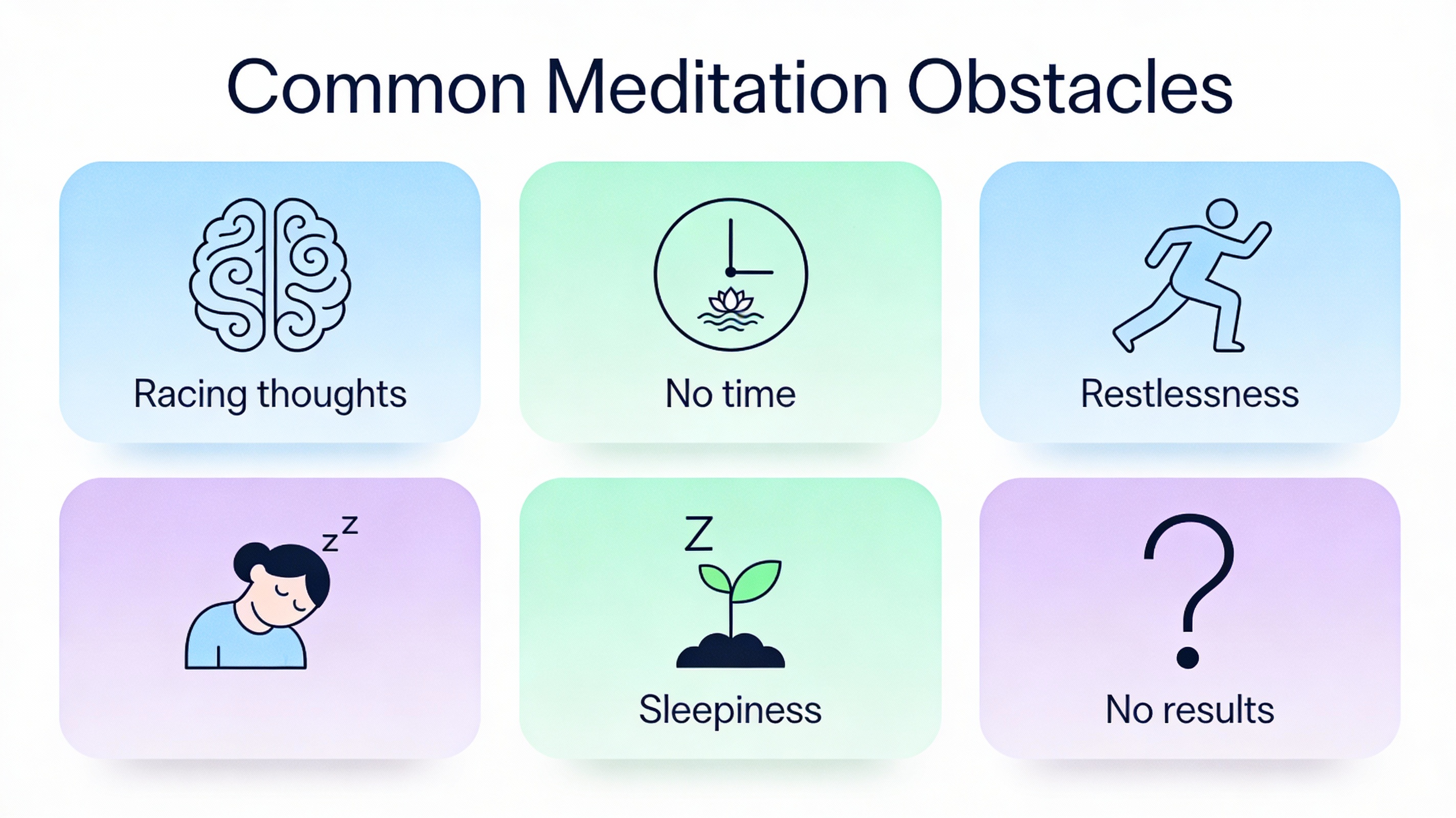
Obstacle 1: "I Can't Quiet My Mind."
The Barrier: The moment you sit, the mental marathon begins. Racing thoughts, overanalyzing yesterday's conversation, thinking about tomorrow's to-do list. The frustration builds: "Why can't I just turn it off?!"
The Shift: This is the most crucial mindset change in meditation. Meditation is not about having no thoughts. It's about changing your relationship to them. Imagine your thoughts as clouds passing across a deep, calm sky (your awareness). You don't control the clouds; you just notice them passing by.
Technique: Try "Noting." When a thought arises, silently and kindly label it. "Thinking." "Planning." "Worrying." Then, like gently setting down a book, return your attention to your breath or a physical sensation. This creates a tiny but powerful gap between you and the thought, diminishing its power.
A Tool That Helped Me: When I was particularly stuck in my head, I tried the Muse 2 Brain-Sensing Headband. It gives real-time audio feedback (calm weather sounds) that changes as your mind settles. It was a game-changer for visualizing what "calm" actually felt like in my noisy brain. It taught me that a "busy" session wasn't a failure; it was just a different kind of weather in my mind.
Obstacle 2: "I Don't Have Time."
The Barrier: Between work, life, and the endless scroll, finding 20 or 30 minutes feels impossible. So we skip it, promising "tomorrow."
Solution: Micro-Meditations. Consistency beats duration every single time. The goal is frequency, not marathon sessions.
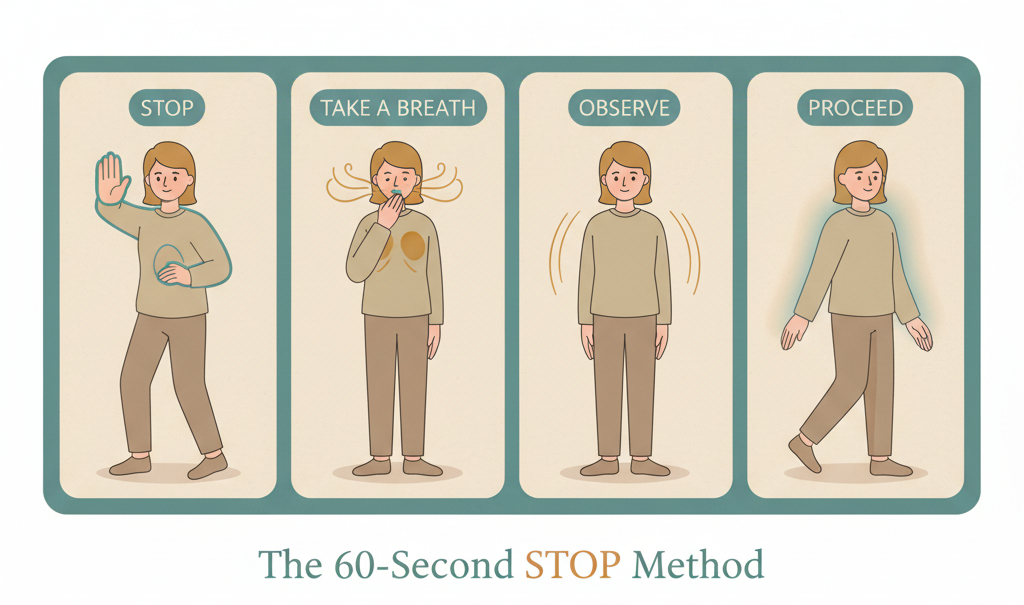
Technique: The STOP Method. It takes 60 seconds, and you can do it anywhere:
- Stop what you're doing.
- Take a deep breath.
- Observe your body, thoughts, and surroundings without judgment.
- Proceed with more awareness.
Practice this while waiting for your coffee to brew, at a red light, or before you open a new browser tab. Anchor your practice to something you already do. For more practices, see our guide to Meditations for Your Morning Routine.
Remember: "Two mindful minutes repeated daily do more than a perfect 30-minute session once a month."
Obstacle 3: "I Get Restless or Uncomfortable."
The Barrier: Physical stiffness, an itch, a cramp, or just a buzzing energy that screams "MOVE!" This physical discomfort becomes the entire focus of your session.
Solution: Move first. Your body might need to release energy before it can settle into stillness.
Technique: Do 2-3 minutes of gentle stretching or yoga before you sit. Try cat-cow stretches, forward folds, or neck rolls. If restlessness persists during your sit, try a walking meditation. Feel the sensation of each foot lifting, moving, and placing on the ground. Movement and mindfulness can coexist beautifully.
A Tool That Helped Me: Investing in a proper meditation cushion (zafu) was a revelation. It tilts your pelvis forward, supporting a natural spinal curve so your back isn't straining and your legs don't fall asleep. When my physical discomfort faded, my mental focus deepened almost effortlessly.
Obstacle 4: "I Fall Asleep."
The Barrier: You sit down to meditate and... wake up 10 minutes later, wondering what happened. This is especially common if you practice when you're already drained (like right after work or in a dark room).
Solution: Adjust your timing and posture. Meditate when you have a gentle alertness, like mid-morning or early afternoon. If you're tired, try meditating with your eyes slightly open, with a soft gaze on the floor. Or practice in a brighter room, perhaps with a candle to focus on. You can even try a standing meditation. Mindful.org has a great guide to different styles that can help you experiment.
Obstacle 5: "I Don't See Results."
The Barrier: You've been practicing for weeks, but you're not feeling more "enlightened," permanently calm, or spiritually awake. Impatience creeps in: "Is this even working?"
The Shift: Meditation is a journey, not a destination. The benefits are often subtle and cumulative. You might not feel different during the practice, but notice the spaces between your practices. A slightly longer pause before reacting in traffic. One deeper breath during a stressful moment. A moment of genuine appreciation for your morning coffee.
Technique: Keep a tiny journal. After you meditate, write down one word about your state: "scattered," "calm," "sleepy," "resentful." Or note one small shift you observed later in the day: "Listened better in a meeting," "Felt less road rage." This creates a record of your subtle progress.
A Tool That Helped Me: The Five-Minute Journal became my non-negotiable companion. Its simple format (morning gratitude and intentions, evening reflections) helped me spot the micro-shifts that meditation was fostering in my daily life. Seeing the word "patient" or "present" show up again and again in my entries was the proof I needed that growth was happening, quietly.
Building a Habit That Sticks in 2024
Knowing how to handle obstacles is one thing. Making meditation a natural part of your life is another. Here's how to build the habit.
Strategy 1: The secret is "Habit Stacking." Here's how it works: connect your new meditation routine to something you already do every single day.
For example:
- Right after you pour your morning coffee, take just three mindful breaths.
- Right after you brush your teeth at night, pause for a 2-minute body scan.
Your existing habit acts as a natural reminder. This method, popularized by James Clear in his book Atomic Habits, makes building a new routine much easier.
Strategy 2: Use Technology Wisely. Let apps serve you, not distract you. For beginners, guided meditations are like training wheels. They give your busy mind a gentle voice to follow.
- Insight Timer (my personal favorite) has thousands of free guided meditations and a supportive community.
- Calm and Waking Up offer excellent, structured courses for beginners.
Using an app can remove the pressure of "doing it right" and provide gentle structure. Many offer free trials; find one whose teacher's voice and approach resonates with you.
Wrap-Up Note: Tiny, repeated actions build identity. You don't meditate because you are a "meditator." You become someone who meditates because you simply do it, day after imperfect day.
When to Seek Guidance
Sometimes, resistance is more than just a distraction. If you encounter intense emotional surges, trauma memories, or deep-seated anxiety that feels overwhelming during practice, it's a sign to seek support. There's a difference between normal mental chatter and psychological pain that needs compassionate, professional holding.
A skilled mindfulness teacher or a therapist trained in somatic or mindfulness-based approaches can be invaluable. They can help you navigate these waters safely. While apps are fantastic for guidance, humans are essential for heart-centered support. You can find certified teachers through resources like the Mindful.org Teacher Finder.
"Apps guide practice, humans guide hearts. Sometimes we need both."
The Path Is the Goal
Let's bring this home. Your meditation journey will not be a straight line upward toward perpetual peace. It will be a spiral. Some days will feel clear and easy. Many will feel clunky and distracted. This is all part of the path.
Every time you notice you're lost in thought and choose to come back, you are strengthening your mindfulness muscle. Every time you sit for two minutes when you'd rather scroll, you are voting for a new way of being. Every obstacle you meet with curiosity instead of criticism is a milestone.
Your mind isn't broken, it's waking up. And waking up is a messy, beautiful, non-linear process.
So start small. Be fiercely kind to yourself. And when tomorrow comes, just sit again. That's it. That's the entire, glorious practice.
Ready for your first week? Let's make it simple. Come back to this article each morning for the next 7 days. Focus on just one obstacle at a time. Start with "I Can't Quiet My Mind" tomorrow, and try the "Noting" technique. The day after, tackle "I Don't Have Time" with the STOP method. Let this guide walk you through, one day at a time.
Disclosure: This post contains affiliate links for products like the Muse headband, meditation cushions, The Five-Minute Journal, and meditation apps. If you purchase through them, I may earn a small commission at no extra cost to you. I only ever share tools and resources I have personally used, loved, and found genuinely helpful on my own journey. Your trust means everything.




Comments (0)
No comments yet. Be the first to comment!
Leave a Comment