Table of Contents
My Everyday Altar: Magic in the Mess
Have you ever walked through the narrow, bustling streets of Asan in Kathmandu or the busy markets of Bangkok? If you have, you'll notice something beautiful. Amidst the honking motorbikes, the dust, the shouting vendors, and the tangled electrical wires, there is always a small corner of peace.
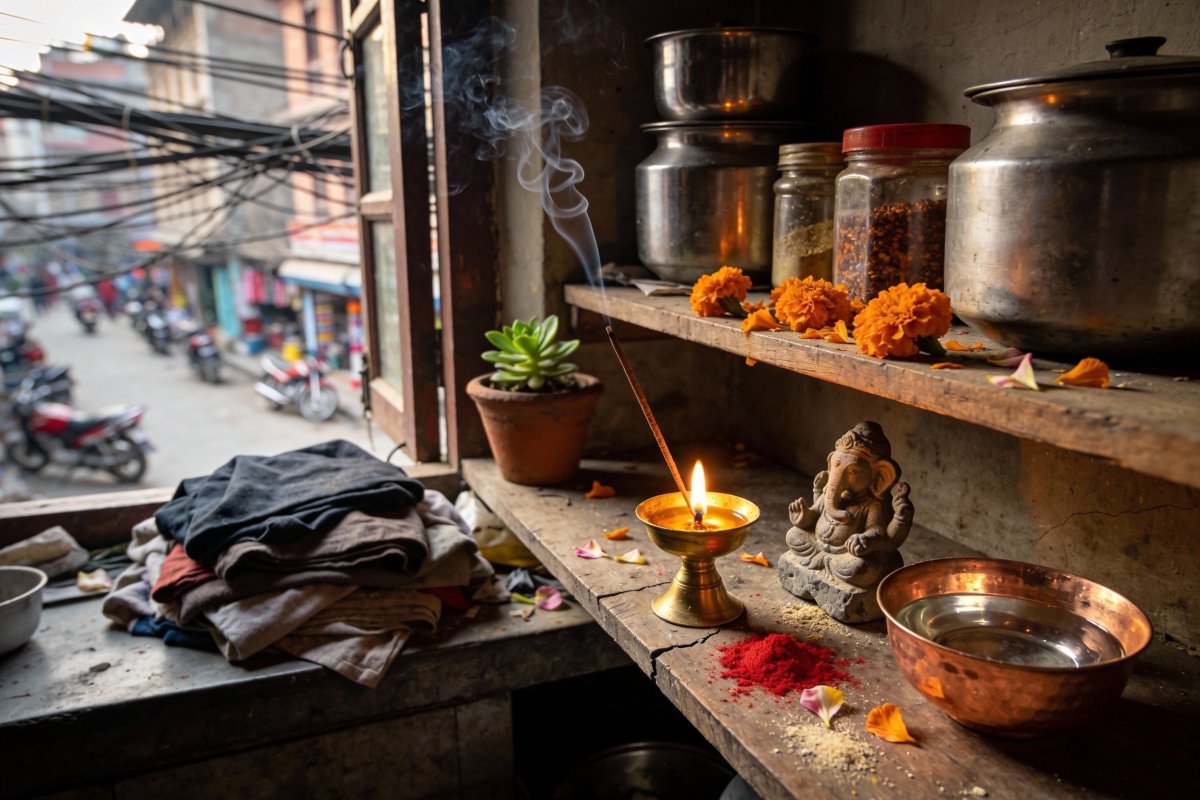
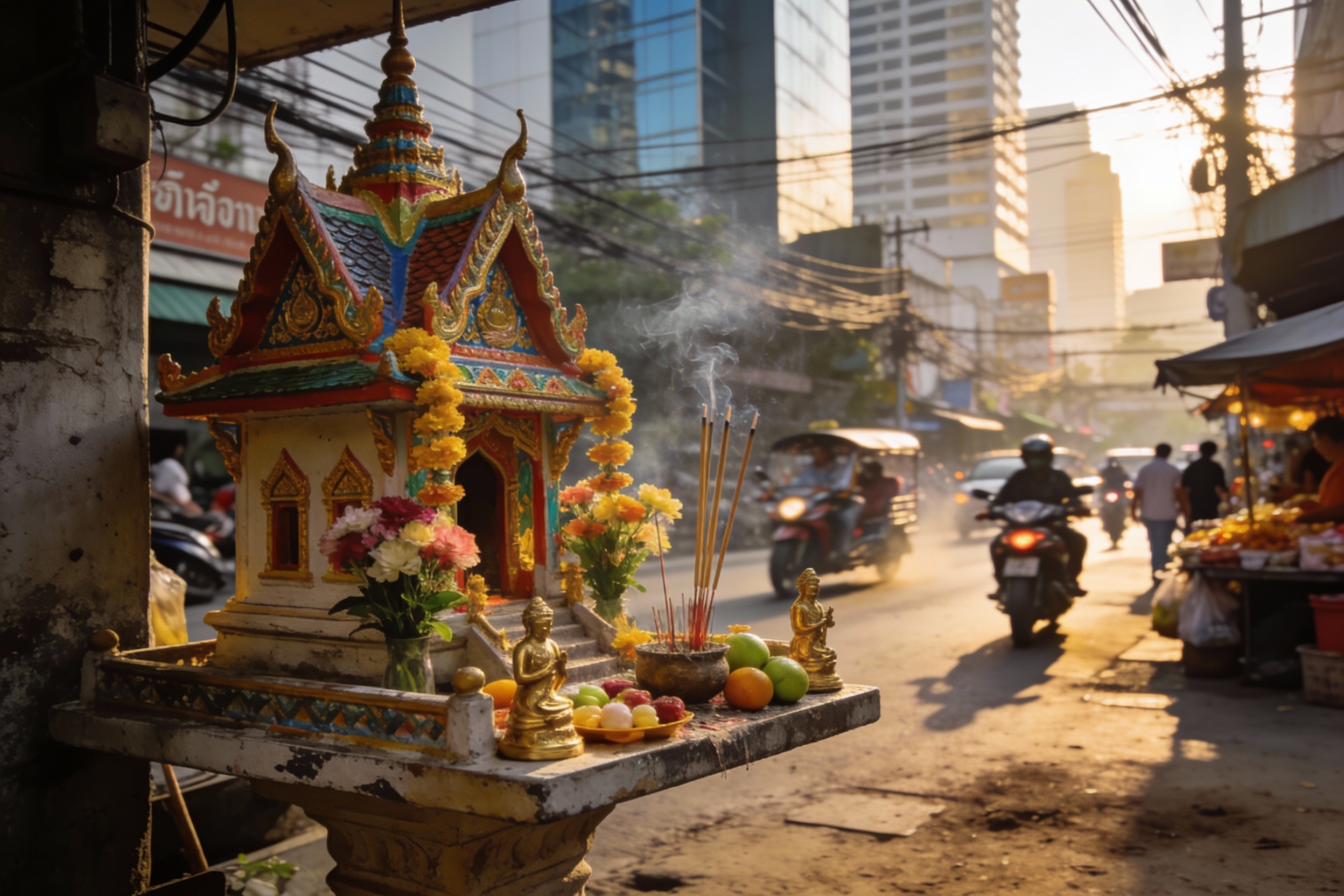
In Nepal, it might be a tiny stone Lord Ganesh or some goddess tucked into a wall, covered in red abir powder and fresh marigolds, with incense. In Thailand, it's a colorful "Spirit House" sitting right outside a high-rise office building.
These are everyday altars. They don't exist in a vacuum of silence. They exist right in the middle of the "mess."
For many of us, our modern lives feel messy. We have emails to answer, laundry to fold, and a never-ending to-do list. We often tell ourselves, "I'll start my meditation practice when the house is clean," or "I'll build a sacred space when I have a bigger room."
But here is the secret: The magic is not in the perfection. The magic is in the mess. Today, I want to show you how to create an Everyday Altar, a simple, small, and sacred space that brings peace to your jumbled life.
What Exactly is an "Everyday Altar"?
Before we dive into the "how-to," let's define what we are talking about. An altar is simply a dedicated space where you place objects that have meaning to you. It is a physical "anchor" for your mind.
Our brains are always taking in our surroundings, almost like a background scanner. If everything we see is purely practical, just a desk, a computer, a sink, our minds get the signal to stay in "work mode." But if we put just one thing in view that means "calm" to us, something magical happens. The simple act of looking at it sends a direct message to our nervous system: it's okay to relax now.
In places like Nepal, this isn't some new 'wellness trend' you read about online. This is just how life is lived. In a typical home here, the morning doesn't start with the smartphone screen. It begins with the gentle glow of a diya lamp. There might be a whole room set aside for routine prayer, or it might be a small, dedicated shelf right in the kitchen, crowded next to the tea tin. But that space isn't an afterthought. It's the home's spiritual heart, the quiet place where the family recharges its sense of peace before the day begins.
How a Simple Shelf Can Anchor Your Chaotic Days
If you visit a home in South Asia, you will see that the altar isn't kept in a soundproof box. It is usually right in the heart of the house.
1. The Nepali "Pooja Kotha" (Prayer Room)
In Nepal, the domestic altar is a living thing. You will find incense (dhup), a small oil lamp (diyo), and photos of ancestors. The "mess" of daily life, the smell of cooking curry, the sound of kids getting ready for school, mingle with this space. This teaches us that spirituality is not an escape from life; it is a way to handle life.
2. The Japanese "Wabi-Sabi."
The Japanese philosophy of Wabi-Sabi is essential for our "Magic in the Mess" topic. It is the art of finding beauty in imperfection. A cracked ceramic bowl or a fading flower on an altar is not a "fail." It is a reminder that life is flowing and changing.
3. The Spirit Houses of SE Asia
In places like Thailand and Vietnam, small shrines are placed outside homes to honor the land. It acknowledges that we are guests in nature. Even if the street outside is noisy and dirty, the spirit house remains a point of dignity and respect.
Why You Need an Altar (The Science Part)
You might be thinking, "This sounds nice, but I'm not religious." That is perfectly okay. You don't need to be religious to benefit from an everyday altar.
Cognitive Offloading: Your Brain's Favorite Shortcut
Forget the fancy word. Think of it this way: you're letting a physical object hold a thought for you. When you look at the candle on your desk, your brain doesn't see just a candle. It remembers, 'Oh, that means breathe.' This cognitive offloading, your brain's favorite shortcut, means you're training your mind to find calm instantly. Learn more about cognitive offloading from Psychology Today.
The Psychology of Ritual
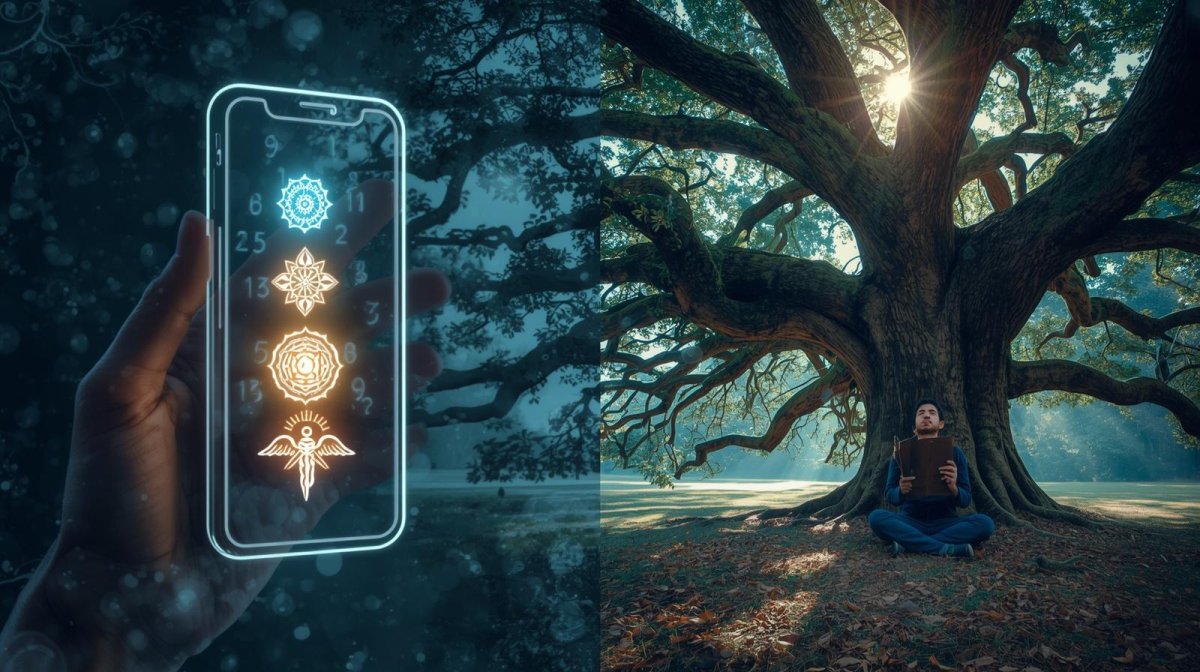
Having a physical space encourages you to step away from your screen. Even a 30-second gaze at your altar can lower your cortisol (stress hormone) levels. This taps into the powerful psychology of ritual, which involves simple, repeated actions that signal safety to our nervous system. For more on how small habits change your brain, check out our previous post on Micro-Habits for Mental Clarity.
How to Build Your Everyday Altar (Even in a Messy Room)
Building an altar should not be another "task" on your to-do list. It should be a joy. Here is how you can do it using what you have, plus a few intentional items.
Step 1: Find Your "High-Traffic" Corner
Don't put your home altar in a guest room you never visit. Put it where the mess is!
- The Kitchen Window: Perfect for staying mindful while doing dishes.
- The Corner of Your Desk: To help you breathe during stressful work calls.
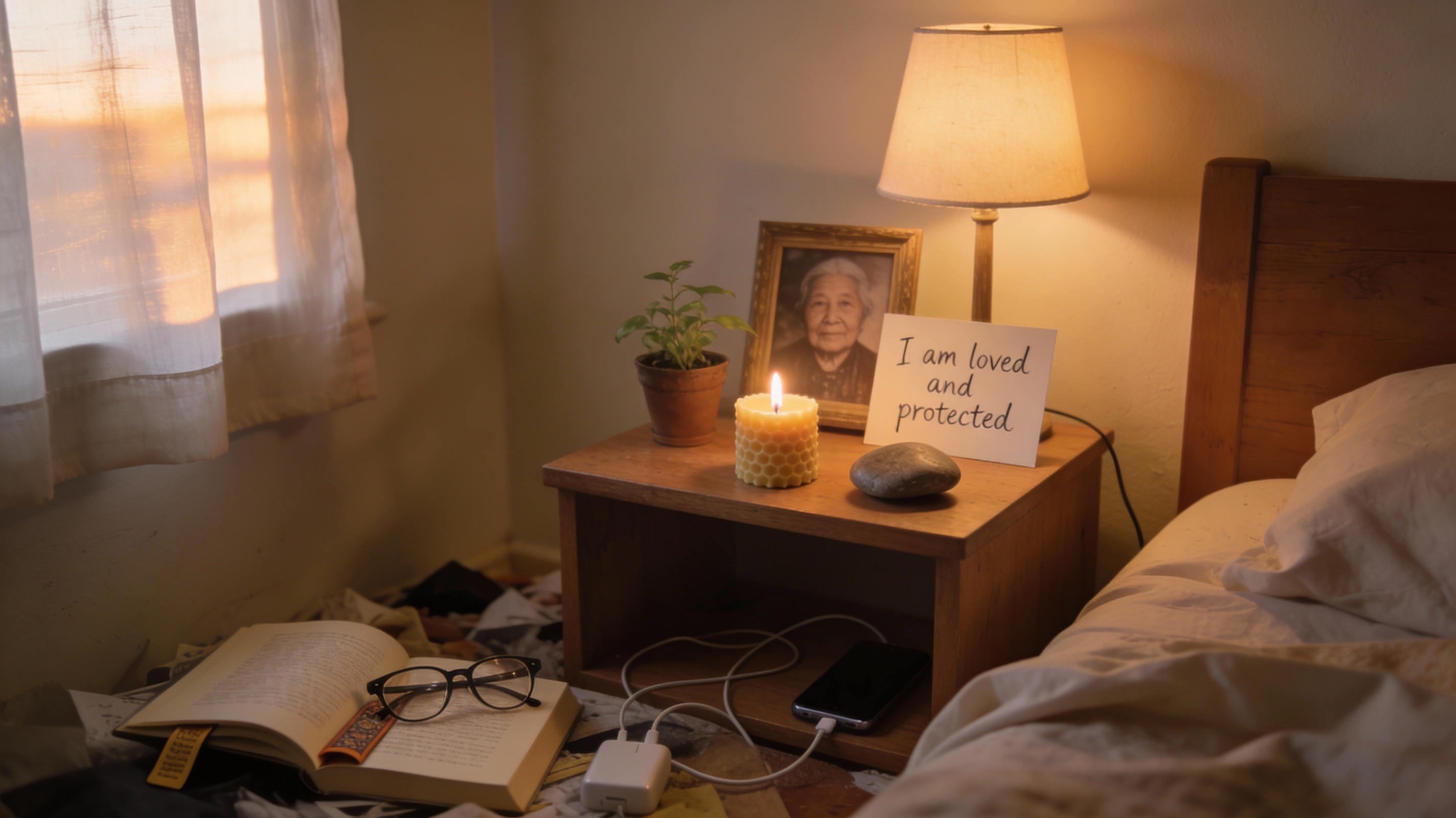
- Your Bedside Table: To set an intention before sleep.
Step 2: The Four Elements
A balanced domestic sacred space usually represents the elements of nature. This grounds us.
- Earth: A stone from a local river, a small plant, or even a bowl of rice.
- Water: A simple, small copper bowl of fresh water (common in Himalayan traditions).
- Fire: A candle or a small oil lamp.
- Air: Incense or a feather you found on a walk.
Step 3: Add the "Human" Element
This is where the "Magic" comes in. Add something that makes you smile. A photo of your loved one, a shell from a beach trip, or a quote written on a piece of paper.
Essential Tools for Your Home Altar
(A quick note: Some links below are affiliate links, which support the blog at no extra cost to you. I only recommend items I genuinely love.)
- Natural Beeswax Candles: Unlike paraffin candles, these clean the air and have a soft, natural honey scent. Check out these Hand-Rolled Beeswax Candles on Amazon.
- A Simple Tibetan Singing Bowl: The sound is a great way to "clear the energy" of a busy room. View this Hand-Hammered Singing Bowl.
- Sandalwood Incense: For that authentic Asian temple smell that instantly calms the mind. Grab some Natural Sandalwood Incense Sticks.
- A Small Plant: Short on space? A little live plant is the perfect 'Earth' item. Even a tiny succulent in a small pot will do the trick.
The "Mess" is the Point: A Story from Kathmandu
Let me tell you a story. A few years ago, I visited a friend in a crowded neighborhood in Lalitpur, Nepal. Her house was tiny. There were four children, two grandparents, and a dog, all living in a small home with three rooms.
The kitchen was "messy" with pots and pans everywhere, the smell of spices, and the floor being swept. But in the corner of that kitchen was a small wooden shelf. It had a small brass lamp, a photo of her late father, and a fresh hibiscus flower she had picked that morning.
Every morning was a storm of activity: making lunches, finding lost shoes, getting everyone out the door. But in the center of that storm, she had her own ritual. It took no more than a few seconds. She'd light the lamp's small flame, let her fingertips rest on the day's flower, and close her eyes. That tiny pause was her anchor, holding her steady in the hectic tide.
That few-second ritual didn't make the mess go away. But it changed her relationship with the mess. She wasn't a "stressed mom" anymore; she was a woman connected to her lineage, her earth, and her breath.
Simple Rituals for Your Everyday Altar
Once your domestic sacred space is set up, what do you do with it? You don't need a 30-minute meditation script.
- The Morning Greeting: As soon as you wake up, go to your altar. Light a candle. Say one thing you are grateful for.
- The "Work-Reset": If you feel overwhelmed by emails, look at your altar for three full breaths. Don't check your phone. Just look at the flame or the plant.
- The Water Offering: In the Buddhist tradition, offering a fresh bowl of water every morning is a sign of generosity and a reminder that life is fluid. At night, pour the water into your plants. Nothing is wasted.
FAQs about Everyday Altars
Q: Do I need to be religious to have a home altar?
A: Not at all. Your altar can be a "Gratitude Station" or a "Memory Corner." The goal is intentional living and mindfulness, not dogma.
Q: What if I have pets or kids?
A: Safety first! Use LED battery-operated candles instead of real fire if you have curious cats or toddlers.
Q: My house is small. Can I still have a domestic sacred space?
A: Yes! An altar can be as small as a coaster. A single stone and a small ring on a shelf can be an altar. This is the essence of wabi-sabi interior design, finding beauty in small, imperfect spaces.
Conclusion: Embrace the Magic in Your Mess
We live in a world that tells us we need to be perfect. We need the nice, perfect body, the perfect career, and the perfect "Pinterest" home. But the traditions of Nepal and the rest of Asia teach us something different. They teach us that the sacred space exists within the ordinary.
Your messy desk is where you create. Your messy kitchen is where you nourish your family. Your messy living room is where you make memories.
Don't wait for the mess to clear to find your peace. Build your Everyday Altar right in the middle of it. Let it be a small island of calm in the beautiful, chaotic ocean of your life.
Do you have a small sacred space in your home? I would love to hear about it! Leave a comment below or tag me in a photo of your "Messy Altar" on social media.



Comments (0)
No comments yet. Be the first to comment!
Leave a Comment